Upon graduating from Wheaton College in 1923, Muriel Fuller studied journalism at various universities before embarking on a celebrated career as editor, writer, and reviewer.  A keen litterateur, she was employed with Rand McNally, Thomas Nelson and the Greystone Press. At Wheaton her roommate was Margaret Landon, author of Anna and the King. In fact, it was Fuller who encouraged Landon to write it. Fuller possessed a rare gift for not only placing her finger on exactly what was wrong with a manuscript, but also offering pointedly useful suggestions toward correcting the problem. Fifteen published books are dedicated to her, with further evidence of her high regard seen in a short 1950 typewritten reply from Ray Bradbury, archived in the Fuller Family Papers (SC-87). As a professional reader for both Redbook Magazine and the O. Henry Memorial Award, she evidently tendered a few friendly remarks, including advice about assembling his stories into an anthology. Bradbury responded with gratitude and availed himself to chat as opportunity allowed. Recently the 88-year-old Los Angeles-based author of Fahrenheit 451 and The Martian Chronicles was alerted to the fact that Wheaton College’s Special Collections has the letter. “I want it!” he said. The staff sent a copy to Bradbury. When it was read to him, he exclaimed, “That’s wonderful!” before tucking it into his voluminous files.
Category Archives: Uncategorized
Dave the Plumber
The final debate between John McCain and Barak Obama in the 2008 Presidential race referenced real-life “Joe the Plumber” who struggled on where to place his vote and whether the candidate’s proposed economic plans would negatively impact him and his business. Thirty-five years ago there was talk in America about a few other “plumbers.” These plumbers didn’t carry monkey-wrenches or copper pipes but did release upon this country a flood suspicion, disappointment and cynicism that plagues politics to this day.
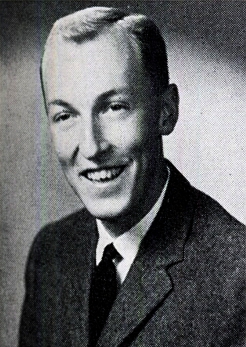 David R. Young, Jr., born in 1936 in Jersey City, New Jersey, received a bachelors of science degree in physics from Wheaton College, Illinois in 1959, where he played soccer, sang in Men’s Glee and was a member of the physics Honors Society, Sigma Pi Sigma. He then went on to receive a law degree from Cornell University. Later, he he was employed in the law offices of Millbank, Tweed, Hadley and McCloy, New York. It was from here that he was appointed a special assistant at the National Security Council in the Nixon Administration and an administrative assistant to Henry Kissinger. In 1971, Young was assigned to the Domestic Council, where he worked with one of John D. Ehrlichman’s deputies. Young’s task was to investigate information leaks within the Nixon administration. Young and his boss, Egil Krogh, founded the White House Special Investigations Unit that eventually was known as “The Plumbers.” The moniker came about because plumbers “stop leaks.” Legend has it that Young chose this name because his grandfather was a plumber.
Other members of the Plumbers “union” were Howard Hunt and G. Gordon Liddy. The Plumbers, who were obviously not plumbers, and it would appear not good burglars either, are most known for the attempted burglary of a psychatrist’s office in 1971 and the attempted 1972 burglary of the Democratic National Committee offices at the Watergate complex. The revelations of the break-ins and subsequent cover-up brought forth a Congressional investigation that resulted in Young’s resignation from government service. He was granted limited immunity and spared jail-time.
A few years after this Young moved to Oxford, England and completed a doctorate. He went on to found and lead Oxford Analytica, an international consulting firm that draws upon the expertise of Oxford faculty. He has, since 1975, served as Lecturer in Politics at Queen’s College, Oxford. He has also been Senior Associate Member of St. Antony’s College, a Dominus Fellow of St. Catherine’s College, and Senior Common Room Member of University College. He has served as an Associate Member of the Royal Institute of International Affairs and the International Institute of Strategic Studies since 1980.
The National Archives and the Nixon Library both house archival materials related to Young, “The Plumbers,” the Watergate scandal, and related legal actions. The Wes Pippert Papers (SC-56) also contain resources related to the Watergate scandal. Pippert was the principal United Press International (UPI) reporter on Watergate from 1973 to 1975.
Surprising Work of God published.
 There is a resurgence of interest in how evangelicalism–today’s version–began. What are its roots? How did it emerge and grow? Several individuals played key roles in the growth of this “new” evangelicalism. One of the central leaders was Boston’s Harold John Ockenga, pastor of the historic Park Street Congregational Church. Ockenga also helped found Fuller Theological Seminary, Gordon-Conwell Theological Seminary, the National Association of Evangelicals, and Christianity Today. Garth Rosell’s The Surprising Work of God: Harold John Ockenga, Billy Graham and the rebirth of Evangelicalism examines the birth and development of modern American evangelicalism–its history, personalities, and institutions. The history of that time is seen through the window of the life, ministry, and writings of Ockenga and his long friendship with Billy Graham. This book will be of value to anyone with an interest in the American Christianity of the last century. Rosell utilized the records of the National Association of Evangelicals (SC-113) for this publication.
How I met Muriel on the Internet.
Relationships emerge in the strangest of places. Decades ago computer dating came upon the scene as a solution for many as a way to meet people. Today, folks spend hours in chat rooms hectically typing away as fast as their little fingers can with bursts of LMK, BTW, and IMO. A secret code of friendship goes on and on with the chiclets of keystrokes.
I didn’t meet Muriel in a chat room as increasingly more and more individuals have met their spouses in this Internet age. I met Muriel on Ebay. Ebay is that vast auction house that has no address other than www.ebay.com. Here thousands upon thousands of new, used, and abused items go on the auction block each day. Eager buyers bid on items ranging from a Donny Osmond Signed Shirt from the Rosie Show to a rare Johnson & Johnson Dental Floss Tin. I met Muriel amidst this wonder.
I met Muriel as I’ve had many others. As the College Archivist every now and then I will prowl the Internet and Ebay for wonders from Wheaton’s past. I search for websites about Wheaton and by our alums. Every few weeks or months I travel to Ebay and plug in “wheaton college.” Often I’m given a listing of used books by faculty or alums of Wheaton. At other times I browse through a list of items relating to the “other” Wheaton, the one in Massachusetts. These items have ranged from coffee mugs to a Public Safety patch emblazoned with the school’s motto, adopted in 1912, “That they may have life, and may have it abundantly.”
Not too long ago I made my usual trip to Ebay and typed in “wheaton college.” To my surprise I saw a listing with the title “Antique Letters (3) and Envelope-Genealogy.” This was my introduction to M. Muriel Ramsay ’26. I quickly placed a bid for the current asking price of $4.00. Admittedly I was bidding against someone who may have had a tie to the letters or to Wheaton, but I quickly rationalized that if the college owned the letters they would become available to others in the college’s archives. I waited with anticipation for the auction to close. You see I had missed out on a large cache of diaries and letters, over 1,000, from two students in the 40s because I hadn’t acted quickly enough. Well, the auction closed and with the addition of a few dollars for postage the letters were on their way from an “Ebayer” in Sioux Falls, SD.
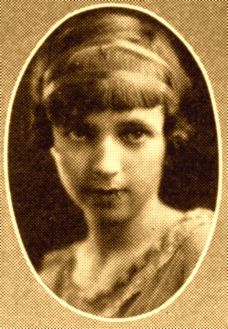 Muriel arrived in the hustle and bustle of an average working day amidst the stacks and stacks of paper that can often accumulate in the Archives’ mailbox, let alone accumulate in the Archives itself. With a level of disinterest I opened a non-descript brown-paper envelope to the surprise of “Antique Letters (3) and Envelope-Genealogy.”
Let it be known that I was not previously introduced to Muriel. I didn’t know her from Adam, or should that be Eve. At the bidding I simply knew that these were three letters written by a Wheaton student in the 1920s to “Vi” and “Jo” in Milwaukee (actually Misses Violet and Johanna Krejci). When they arrived it was clear that my work had just begun.
Who was Muriel? At first reading of the letters with reference to Williston Hall I surmised that it could be Muriel Fuller, ’23, classmate and friend of Margaret Landon. However, as I dug into the other letters they were dated in 1924,too late for Muriel Fuller. Now the chase was on! Using handy resources created by past archivists Thad Voss and Mary Dorsett I searched a listing of students from past college catalogs. This resulted in three possible Muriels. One was Muriel Fuller and the others were Muriel Curtis and M. Muriel Ramsay. Muriel Curtis had also enrolled in the Conservatory, as well as the College. Usually at that time Conservatory students lived locally, though not always. I then looked in the 1922 catalog to see where Muriel Ramsay was from since the older catalogs listed each student’s hometown. Muriel Ramsay was from Milwaukee, Wisconsin. Muriel had a home. I quickly scanned the 1923 Tower to find a photograph or references to her. Muriel was Corresponding Secretary for the Aeliolian Literary Society her first semester at Wheaton and was Assistant Librarian for the Women’s Glee. Muriel had a face and a life.
Muriel’s letters spoke of her joy of being at Wheaton. She described the troubles of her first weeks, but also how she loved every moment. She tells “Vi” and “Jo” that there were “a hundred! social functions that a green little Freshie, simply must take in, during these first glorious days of school life.” She continues that “the spirit of the place simply chases little thrills down my spine one after another. I’m so happy I’m alive!.”
I found a friend on the Internet. From her letters she told of a life of fun, football, missionary zeal, and the love of friends. I’ve not met her personally or talked with her on the phone, but with our shared hope I’m sure we’ll meet someday.
Bombay Anna published from Special Collections research
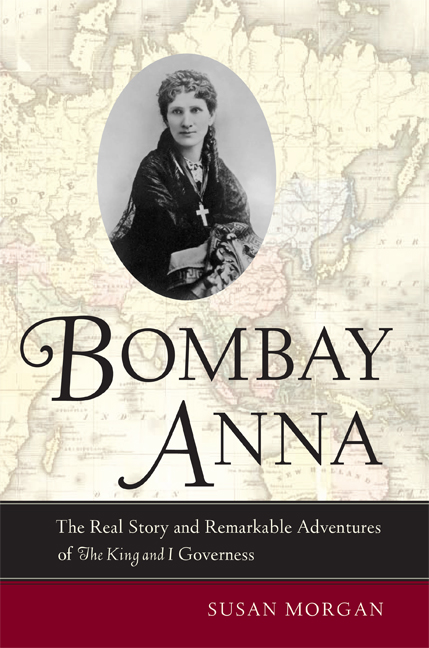 Bombay Anna, written by Susan Morgan, is another retelling of the life of Anna Leonowens. Morgan conducted in-depth research in the Kenneth and Margaret Landon papers seeking to reveal the history of this enigmatic figure. Anna’s origins have been less clear in years past and Morgan seeks through this volume to bring clarity to the situation. This was especially difficult because Leonowens was not truthful about her humble beginnings.
Despite her revelations to the contrary, Leonowens was born on November 26, 1831 Anna Harriett Emma Edwards in India to a British soldier and his young wife. Leonowens grew up in Army barracks amidst a diversity of ethnicities and cultures. It was a rather bleak beginning. Leonowens herself married young and continued the military connection until she found herself widowed with two small children. Leaving India Leonowens charted a new course for her life embellishing her pedigree and credentials to become the governess to the children of King Mongkut (Rama IV). It was this Anna that previous biographies have presented–an upper-class British woman who faced tragic loss before becoming a beloved governess in Siam. It is this Anna immortalized in the adaptation of Landon’s Anna and the King of Siam (1944) and later as Rodgers and Hammerstein’s 1951 musical The King and I.
Landon was hampered by wartime restrictions and limited access to Asian archives. Landon enjoyed great success from her book and its adaptation, which must have left her with feelings of ambivelance since she disliked Rodgers and Hammerstein’s final product. Morgan reveals more about Leonowens, in part because more primary sources have become available. Leonowens left Siam (modern-day Thailand) after five years and made her way to America where, Morgan says, another phase of embellishment began. She published The English Governess at the Siamese Court (1870) and The Romance of the Harem (1873) to the interest of many who wanted to learn of the exotic East. Leonowens later left New York for Canada, settling in Montreal and Halifax to spend time with her daughter and grandchildren.
A Forgotten President
 When President Charles Blanchard died from a heart attack at age 77 in 1925, Dr. John Wallace Welsh, pastor of College Church, college trustee and occasional instructor, was called to serve as acting president ad interim. Blanchard’s successor was originally intended to be W.H. Griffith-Thomas, the Reformed Episcopal author, Keswick Conference preacher and co-founder (with Lewis Sperry Chafer) of Dallas Theological Seminary. The plan was that Griffith-Thomas, when asked to join the teaching staff in 1923, would eventually assume the presidency; but the eminent theologian declined the offer.
Before coming to Wheaton, Welsh, a native of Elmira, N.Y., pastored in Princeton, IL, at the church once led by abolitionist Owen Lovejoy, an original trustee of Wheaton College. During his Princeton years, Welsh enjoyed close association with evangelist Billy Sunday, who preached a sweeping revival from Welsh’s church. The 1927 Tower describes Welsh as “…resourceful, self-reliant, aggressive, unceasing…” He had two sons: John, Jr, who became the college’s first physician, and Evan, who also served as pastor of College Church (1933-46), and later as chaplain for Wheaton College Alumni Relations. John W. Welsh served faithfully during uncertain days until a young evangelist named J. Oliver Buswell was unanimously elected as Wheaton’s third president in 1926. Shortly thereafter Welsh retired from College Church and moved west to do field work for the Los Angeles Bible School. He received an honorary degree in 1925 from Wheaton College. Welsh died in 1947 at age 73 in Newton, Kansas, following a stroke. In addition to his sons, Welsh was survived by his wife, Mary.
Marshall Fields and the King of Siam
 Margaret Landon first read the writings of Anna Leonowens in 1935, while laboring with her husband, Kenneth, as missionaries in Siam. Enthralled by this exotic tale of a young English widow and her son living among Siamese royalty, Margaret determined to edit and recast Leonowens’ autobiographies, The English Governess at the Siamese Court (1870) and The Romance of the Harem (1872), as historical fiction, removing lengthy expository sections and sequentially arranging incidents. But those books were long out-of-print. Where might she secure copies? After extensive searching, Kenneth spied an edition of Romance at the Economy Bookstore in Chicago; a few weeks later, Margaret happened upon Governess at the Marshall Field flagship store on State Street, after a half-hour hunt among tottering stacks of books. Delighted, she paid fifty cents. Margaret then collected correspondence and other material pertaining to Leonowens, and set about her arduous task. Finally, in 1945 she published Anna and the King of Siam, providing the basis for a yet another successful re-tooling, Rodgers and Hammerstein’s musical The King and I. “If I were asked to give the fabric content of the book,” she commented, “I should say it is seventy-five percent fact, and twenty-five percent fiction based on fact.”
Embrace your inner-doodler
 Buechner, an inveterate doodler, writes nearly all of his works initially in long-hand. His papers contain book manuscripts, correspondence, articles, photographs, and published items. Recognized by Pulitzer Prize winner Annie Dillard as “one of our finest writers.” Buechner received an O. Henry Award – Third Prize (1955) and the Critic’s Choice Books Award (1990). Additionally, he has received honorary doctorates from Virginia Theological Seminary (1982); Lehigh University (1987); Cornell College (1989); Yale University (1990); and Wake Forest University (2000). Godric, dedicated to his father, was runner-up for the Pulitzer Prize in 1981. Brendan (1987) was nominated for the National Book Award. He has authored over thirty works of fiction and non-fiction. The papers of Frederick Buechner, author, lecturer and ordained Presbyterian minister, occupies approximately 55 linear feet.
Leanne Payne autobiography published
 Leanne Payne’s autobiography, Heaven’s Calling: A Memoir of One Soul’s Steep Ascent (2008), unfolds the ever-rolling road of an extraordinarily rich and adventurous faith-life, moving gracefully from her childhood to her years as a student at Wheaton College, and finally to her role as author and founder of Pastoral Care Ministries. She describes her passion for healing prayer and sacramental worship, emphasizing the necessity of Christian emblems when re-educating the paganized, or “bent,” mind toward contemplating the holy things of Christ. Along the way she recognizes mentors such as her mother, Charismatic pioneer Richard Winkler and author/teacher Agnes Sanford, Payne devotes an entire chapter to the late Dr. Clyde Kilby. “To say that my debt to Dr. Kilby is very great indeed is to understate the case,” she writes. Payne highlights his efforts in publicizing the works of C.S. Lewis, in addition to describing the unhurried simplicity of Kilby’s classroom teaching and devotional life, both a continuing inspiration to students and notable graduates, including pastor John Piper, author Thomas Howard and poet Luci Shaw. Payne’s prose is musical and distinctly feminine. Her walk of faith is an upward path, and she inspires her readers to a celebration of life in Christ. Leanne Payne’s papers are classified as SC-125 in Wheaton’s Special Collections.
The Galloping Ghost, by Gary Andrew Poole, recently published
 Harold E. “Red” Grange is the most important figure in American football history. In 1924, playing for the University of Illinois, he scored four touchdowns in 12 minutes against Michigan. And so Grange, nicknamed “the Galloping Ghost” by Chicago sports writer Warren Brown, forever secured his reputation as a gridiron legend. Grange dazzled fans, inspired poetry, starred in films, and was the first celebrity product endorser. In 2008 he was ranked #1 on ESPN’s Top 25 Players in College Football History list. But who was the nation’s first football hero? From barnstorming tours to stadium rallies, from the White House to Hollywood, Gary Andrew Poole’s The Galloping Ghost, the first critical biography of “Red” Grange, chronicles the meteoric rise of this extraordinary athlete. Drawing on extensive research and interviews, Poole details not only Grange’s relationship with Bears manager George Halas and his later life as motivational speaker and tv sports commentator, but he also touches on the shadowy aspects of 1920s sports management, exploring the influence of Grange’s agent, the visionary but unscrupulous C.C. Pyle, known then as “Cash-and-Carry Pyle” and now as “the first Jerry Maguire.” The Galloping Ghost is an energetic, perceptive account of a star athlete who defined the finest qualities of American sportsmanship.