All posts by admin

On My Mind – Richard Butman

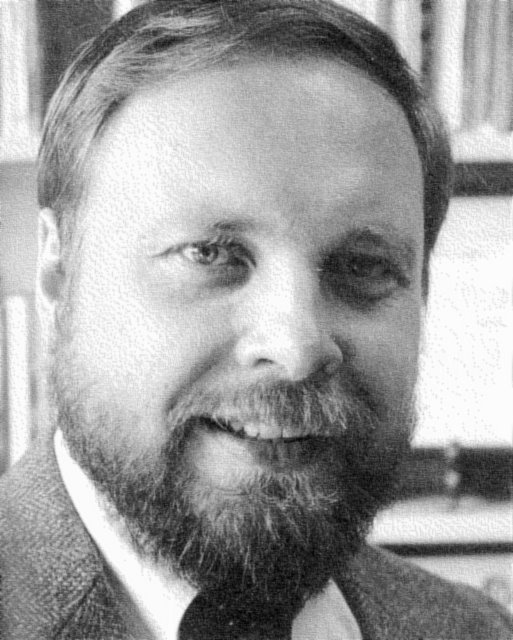
Twenty years ago, the Wheaton Alumni magazine began a series of articles in which Wheaton faculty told about their thinking, their research, or their favorite books and people. Professor of Psychology Richard Butman was featured in the Winter 1992 issue.

One of the most satisfying and stimulating aspects of my job at Wheaton is the opportunity to travel in this country and abroad. Most recently, I had the opportunity to attend a conference on “Power Within Diversity: Confronting Moral Issues in a Multi-Racial/Multi-Cultural Community and World.” Several hundred participants met for four days on the University of Toronto campus in an effort to facilitate dialogue and discussion about those differences and their implications for moral education. That interaction was strongly influenced by the setting of the conference, According to the United Nations, Toronto is now the most culturally and racially diverse city in the world.

One of the greatest challenges facing Wheaton today is how best to come to grips with the increasing pluralism of contemporary society. Few would doubt that we need to be more multi-cultural/ international in our concerns and consciousness than we are at the present. The debate is over how best to become more intentional about that diversity in all aspects of our college life. In short, how do we best equip ourselves to act responsibly as Christians in a pluralistic society where justice for all faiths must be maintained? Put succinctly, this is the challenge of pluralism.

Christian philosopher and ethicist Richard J. Mouw has just written a wonderfully helpful book on the subject called Uncommon Decency: Christian Civility in an Uncivil World (InterVarsity, 1992). He argues that dialogue and discussion are not facilitated when we become extremely dogmatic and rigid (i.e., too much “conviction”) or overly accommodating (i.e., “civility” to the point of advocating relativism). What he does advocate is a kind of “convicted civility,” a humility that doesn’t let our religious fervor blind us to our own humanity or that of the persons with whom we disagree.

An emphasis on personal piety and evangelism has been a rich part of Wheaton’s heritage. In recent decades, that has been increasingly linked to helping the student develop a Christian world-and-life-view. Perhaps the most difficult task we face today is to find ways to equip and motivate students to find distinctively and decidedly Christian ways of being and acting in the world-at-large.

Few of us lack strong convictions at Wheaton. Perhaps where we need to stretch is in the direction of greater civility and humility. For a community that strives to serve the church and society-at-large, we need to be especially sensitive to how we define what it really means to be a Christian in contemporary society. Consider the words of Wheaton alumnus Horace L. Fenton ’32, D.D. ’61:

“We mean to proclaim, ‘Believe on the Lord Jesus Christ, and thou shalt be saved.’ But what we often say is, ‘Believe on the Lord Jesus Christ and accept our cultural patterns, our economic, political, and social outlook, our views of baptism and the Holy Spirit, our interpretation of prophecy, our organizational relationships –and thou shalt be saved” (taken from The Trouble with Barnacles, Grand Rapids, MI: Zondervan, p. 14).

We need to be careful about giving to cultural or social convictions the same standing as truths we have received from divine revelation. Fenton goes on to argue that “If the sin of liberalism is to subtract from the revelation of God, it may well be that the sin of evangelicals is too often an unwitting attempt to add to it” (p. 15). Surely efforts to diversify or internationalize our environment at Wheaton will be thwarted if we add to the revelation of God by too deeply embracing a “cultural style” that expects–or even demands–conformity “for the sake of unity.”

I am not advocating that we cower in timid silence in our increasingly pluralistic society. I do believe it is possible–but never easy–to be both faithful to the Word and respectful of others. If we seriously commit ourselves to exploring that “power within diversity,” I suspect we will learn that the church is vastly larger and richer than we ever dreamed.

———-
Richard E. Butman has taught courses in psychological assessment, psychopathology, psychotherapy, and the psychology of religion at Wheaton since 1980. He received his B.A. in psychology and his M.A. in theological studies from Wheaton and Ph.D. in clinical psychology from Fuller Theological Seminary in Pasadena, California. He is a licensed psychologist in Illinois. His clinical and research interests include the impact of fathers on their children across the lifespan, psychosocial development in young adulthood, and the assessment of religiosity. He was named Junior Teacher of the Year for 1988-89. His current interests include bereavement and psychopathology. He is currently working on collaborative projects in both areas. His commitment to promoting holistic development has lead to direct involvement in ministries in Africa, Asia, Chicago, and Latin America. Dr. Butman has co-authored (with Stanton L. Jones) Modern Psychotherapies: A Christian Appraisal (InterVarsity,1991) and (with Barrett McRay and Mark Yarhouse) Modern Psychopathologies: A Comprehensive Christian Appraisal (Intervarsity, 2005). A second edition of Modern Psychotherapies: A Christian Appraisal is currently being written with an anticipated release in 2011. Dr. Butman is also involved in a shared project in the areas of integration and the spiritual/sociocultural foundations of mental health.

What Wheaton College Did for Me: Harold Lindsell

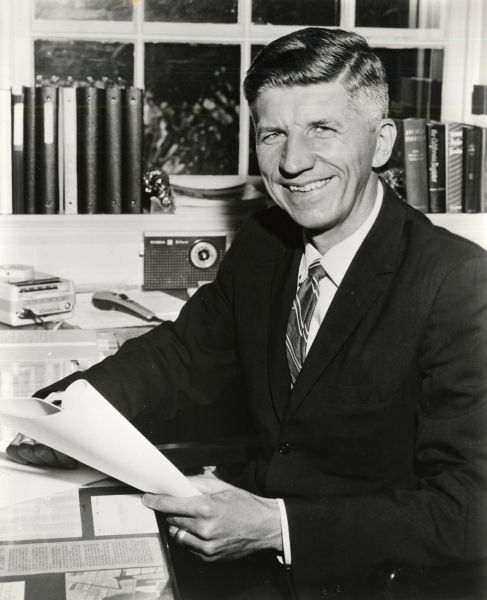
This remembrance by Harold Lindsell appeared in the Wheaton College Alumni Magazine, as part of a series called “What Wheaton College Did for Me.”

LindsellMy life has never been the same for having gone to Wheaton. I came to alma mater having been out of high school and in business for five years. As a result of business experience my objectives were clarified. I came to Wheaton with a definite purpose in mind. I intended to major in business administration and to return to the world I left to go to college. All of this was changed, however. Wheaton’s greatest contribution to my life came in February of 1936 when there was a great revival. The speaker for the midyear evangelistic effort was Robert C. McQuilkin of Columbia Bible College where I later taught. I sat through those days as the Holy Spirit worked graciously and my own life and walk were permanently affected. God broke through human barriers. He spoke and I responded. I changed my major from business administration to history. This, in turn, led later to postgraduate study, the Christian ministry and theological seminary training.

Wheaton afforded me another opportunity for gratitude through the medium of certain faculty members who were genuinely helpful during my college years – Drs. Nystrom, Tiffany, Clark, Edman, Straw and Miss Erickson, to name a few. Teaching is more than books. It is Mark Hopkins on one end of a log and a boy on the other. It is person interacting with person. These were some of the teachers who left an indelible impression on me and who were a special blessing. Wheaton also brought me in contact with students who became fast friends and with whom my life has been intertwined for thirty years. This has been especially true for one who has been in full time Christian service. In all the years of Christian service I have never labored any place where there were not some of the Wheaton graduates with whom I formed friendships on campus. This gift of Wheaton has been a never failing source of blessing to me.

Wheaton also gave me a good liberal arts education. I learned how to study and how to use my time to the best advantage. It brought me to a place in my use of the Bible where, as a student, I determined to read it through once a year – and I have done so for more than a quarter of a century. Perhaps the acid test of one’s opinion of his alma mater is “Would I choose it again if I were commencing my college education today?” My answer to this question is simple: my oldest daughter has graduated from Wheaton; my second daughter is presently a student there; my third daughter looks forward to Wheaton with expectation. And God willing, my only son will become a loyal son of alma mater when his turn comes.

On My Mind – Charles Weber

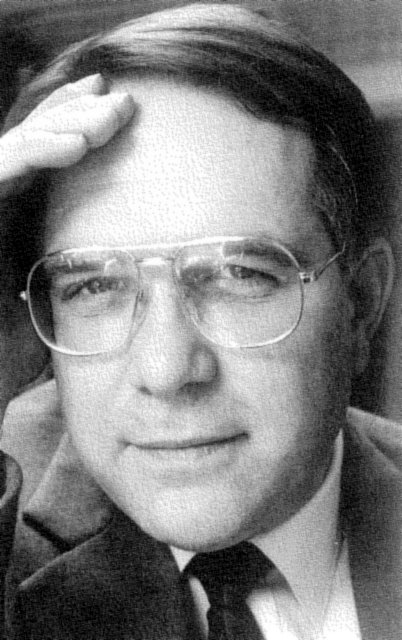
Twenty years ago, the Wheaton Alumni magazine began a series of articles in which Wheaton faculty told about their thinking, their research, or their favorite books and people. Professor of History Charles Weber was featured in the October/November 1992 issue.

Chuck WeberEarlier this year [1992] the Los Angeles Times reported that the word “global” and its derivatives, such as “globalization,” “globalize,” and (worst of all) “global-ability,” is “fast becoming the business cliche of the 1990s.” We can expect that the use of the term global will increase dramatically in business and politics. Simply reading the newspaper and traveling outside North America makes this observation abundantly clear as we consider the long-range implications of the so-called New World Order. For most of us living in North America it is evident that our own society and communities are increasingly more culturally and ethnically diverse. Global change is all around us.

In my own discipline of history there is a growing tendency to emphasize history’s cosmopolitan aspects and to internationalize the discipline both in scope and in its comparative methodology. It is now expected that one must analyze the larger theoretical and international implications of more specific studies.

In many ways the church has led the way in this globalization. Next year marks the bicentennial of the inception of voluntary missionary agencies started by William Carey. These agencies provided a great impetus to the modern missionary movement. While much has been written about the impact of this movement, it has resulted in a significantly different, worldwide Christian community.

Two hundred years ago over 99 percent of all Christians lived in Western cultures. A hundred years ago this figure was about 94 percent. Today about two-thirds of all Christians live in Africa, Asia, Latin America, or Oceania. And the new center of gravity for our Lord’s Church is continuing to shift in this direction.

The prominence of these new churches outside the West is accentuating the global character of the church in many directions. Now these churches outside Europe and North America represent over 1,100 of their own missionary-sending organizations with over 36,000 missionaries. During the last year I have had the privilege of teaching, with Alumni Association assistance, at two centers of the Asian Graduate School of Theology in Indonesia and Korea. What a thrill it is to see the vision of mature, young adults from various parts of Africa and Asia preparing themselves intellectually and spiritually to augment the growth of the church in their home societies and beyond, Likewise their vision has broadened my own.

On campus we are attempting to respond to this globalization. Students must take a course specializing in another culture. Many faculty members and students have involved themselves in academic and ministry activities in regions of growing Christian influence. The College sponsors study programs to East Asia, the Middle East, and various parts of Europe, while the HNGR program encourages, for both students and faculty, study and service in developing nations.

My hope is that as our world becomes more global in its thinking and action–politically, economically, and spiritually–that our thinking will adjust to these new conditions all around us. Our thinking needs to accommodate the new dimensions of the world in which we are living.

———-
Chuck Weber, Professor of History, has been teaching at Wheaton since 1968. He earned both his M.A. and Ph.D. from the University of Chicago in African History and East Asian International Relations. Chuck founded Wheaton’s East Asia study program in 1974 and among the founders of the HNGR program. Dr. Weber’s teaching and research is focused mainly on how African and Asian cultures have developed historically and how they influence the modern world. He is especially interested in how Christians have impacted these societies and the role Christians have played in the development of their national identity.

What Wheaton College Did for Me: Carl F.H. Henry

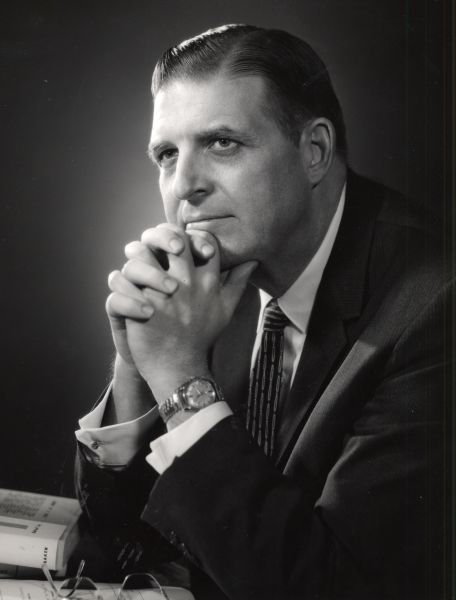
This remembrance by Carl F.H. Henry appeared in the April, 1966, Wheaton College Alumni Magazine, as part of a series called “What Wheaton College Did for Me.”

Carl FH HenryAcademically, high tide at Wheaton came during the senior course in theism and comprehensives, which helped to integrate previous years of study from a Christian perspective. There had been the rigorous discipline of Miss Blaine’s Latin classes, the high humor of Dr. Straw’s logic courses, the intellectual confrontation of Dr. Clark’s philosophy major, and too much more to record. Socially, there was the opportunity to establish enduring evangelical friendships that some day would span the earth, and to find my sweetheart and companion for a lifetime. Vocationally, there was the busy suburban “news beat” for Chicago and Wheaton papers, which helped a former reporter meet the collegiate budget. Devotionally, there were daily chapel, semester evangelistic or revival services, and the house prayer meetings. Spiritually, there were the Saturday night “Midnight Brigade” Sunday school classes at Mooseheart, and preaching opportunities.

All in all, it was a good experience. I have never wanted to undo it. Those of us who rubbed elbows on campus had a sense of destiny in the making. Elsewhere the tide of religion was mainly flowing the other way. We had no option but to drift with that stream or to put evangelical conviction to its test. Alumni went to the ends of the earth, to the frontiers of faith, some to places of peril – and in that time of turbulence they stood firm. It was a great heritage – one we hoped future generations (our children as well) could and would discover and preserve for themselves.

On My Mind – Roger Lundin

Twenty years ago, the Wheaton Alumni magazine began a series of articles in which Wheaton faculty told about their thinking, their research, or their favorite books and people. Blanchard Professor of English Roger Lundin was featured in the April/May 1991 issue.

This spring I taught The Brothers Karamazov for the fifteenth time; I imagine that over the years I have reread it at least ten times. What is striking is that my experience is as fresh today as it was when I first stood trembling before a class in 1979 trying to unravel some of that great book’s many mysteries. Teaching a novel as rich as The Brothers Karamazov does not involve straining to find something new to say about an all too familiar subject; instead, each time I work through that book, I simply try to remain alert to what it is saying afresh to me and my students about the world in which God has placed us.

When I read The Brothers Karamazov for the first time as a freshman at Wheaton in 1968, Ivan and Alyosha Karamazov addressed my deepest anxieties about faith and doubt. I first taught the novel more than a decade later, only a few months after the Jonestown Massacre I was haunted by the uncanny parallels between the world of the Grand Inquisitor and the totalitarian rule of Jim Jones over his sect. And as I taught the book this past semester, the Persian Gulf War brought home the power of Ivan Karamazov’s struggles with questions of suffering, especially the suffering of innocent children. I teach in full confidence that a decade from now this old book will still illuminate the dark and baffling events of that new day.

Several years ago, the Christian critic Edmund Fuller wrote in his valedictory column for the Wall Street Journal that he was unimpressed by the saying, “You are what you eat.” To Fuller, the far more interesting generalization is, “You are what you read.” The “printed word gives us the extraordinary freedom to choose the intellectual company we will keep, to select those with whom, in spirit, we will walk.” That freedom is a privilege, and “in the highest sense it is a duty, in at least a due proportion of our reading time, Paraphrasing Joshua, ‘Choose you this day whom you will read.'”

As an undergraduate, I came to Wheaton as a new Christian in search of the intellectual and spiritual company of which Fuller spoke. When Beatrice Batson, Arthur Holmes, Morris Inch, and others introduced me to the likes of Augustine, Luther, Dostoevsky, and Karl Barth, I prized the opportunity of entering into dialogues with powerful minds struggling with issues of life and death, of justice and forgiveness. I especially appreciated the fearlessness of my teachers in making me confront the most difficult matters of the human spirit. I profited from encountering the negations of Nietzsche as well as the affirmations of Luther; I needed to hear Emily Dickinson’s questioning of God as much I needed to be strengthened by the poetry of George Herbert; and as a Christian trying to comprehend his world, I needed to understand the secularity of Harvey Cox as well as hear modern words of promise from Helmut Thielicke. Whether being challenged or comforted by works from the distant or recent past, I was learning how to live as a Christian by listening to voices from that past.

As I have taught at Wheaton over the last decade, my sense of the power of the past has become coupled with an awareness of the fragility of what Robert Bellah, in Habits of the Heart, calls “communities of memory.” A genuine community, a “community of memory does not forget its past. In order not to forget that past, a community is involved in retelling its story.” This is one service that a Christian liberal arts education can perform for Christ and the Church in a fractured and forgetful world. By bringing to life the history of human thought and suffering, and by doing so in dialogue with the biblical witness, the Christian teacher is helping to hand down what the Apostle Paul calls the “treasure” we carry in our “earthen vessels.”

Teaching at Wheaton, then, involves storytelling of a special kind. In a remarkable recent book, After Virtue, the moral philosopher Alasdair Maclntyre argues that “I can only answer the question ‘What am I to do?’ if I can answer the prior question ‘Of what story or stories do I find myself a part?'” A liberal arts education enables students to see the relationship between their individual stories and the broader cultural story they have been born into and the special history they have become a part of in Christ. The prophet Micah asks, “What does the Lord require of you? To act justly and to love mercy and to walk humbly with your God.” Whatever its flaws, a liberal arts education at Wheaton is a remarkable thing because of the challenge it sets for students and teachers alike to learn afresh what it means to obey such a command.

———-
Dr. Roger Lundin ’71, Blanchard Professor of English, returned to Wheaton in 1978 to teach literature after earning a master of theological studies at Gordon-Conwell Seminary, and his master’s and doctorate in English at the University of Connecticut. He was named junior teacher of the year in 1984 and senior teacher of the year in 1995. Some of Lundin’s published works include: Literature through the Eyes of Faith, Emily Dickinson and the Art of Belief, and Believing Again: Doubt and Faith in a Secular Age.

To the Moon!

On this 40th anniversary year of the Apollo 14 space mission it is appropriate to consider Wheaton’s relationship to space.

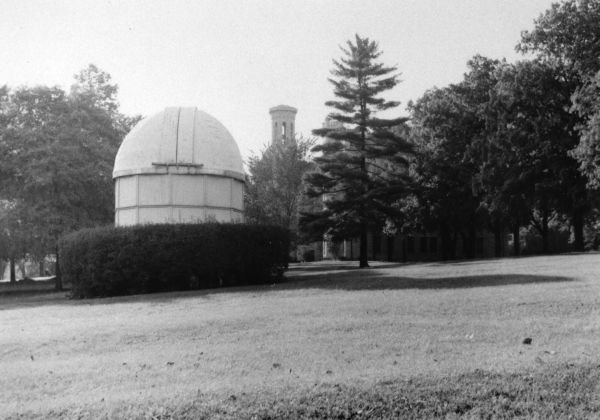
For nearly 70 years a domed observatory, resembling a derelict space capsule fallen to Earth, stood conspicuously on the front lawn of Blanchard Hall. With its telescopic eye poised to the stars, the “Lemon,” as it was nicknamed, informed generations of students about the graceful syncopations of celestial bodies. LemonSince its 1972 relocation to Camp Honey Rock, the Lemon has been replaced by two successive observatories, both situated atop Wheaton’s science buildings. Since its inception Wheaton College has studied the metaphysical Heaven of the Bible, but the observatory symbolizes its engagement with the physical heavens – and those who’ve set their gaze on that boundless expanse.

Harold Lee Alden, born in Chicago, graduated from Wheaton College in 1912. He acquired his master’s degree from the University of Chicago in 1913. After that he earned his doctorate in astronomy in 1917 from the University of Virginia, where he researched at the McCormick Observatory, using its 26-inch telescope, one of the largest in the world. In 1925 Yale developed a new telescope and shipped it to Johannesburg, South Africa, to observe the clear southern skies. Alden, sent to direct the program, lived there with his family for nearly 20 years, returning to the University of Virginia in 1945, where he served as professor of astronomy and director of the Observatory until retiring in 1960. He died at age 74. As one of 500 deceased men and women of science, including luminaries like Jules Verne and H.G. Wells, Alden was honored to have a crater on the dark side of the Moon named after him.

As a youngster Paul W. Gast, also from Chicago, suffered poor health. Often staying home he read books and magazines like Moody Monthly, from which he learned about Wheaton College. “My ambition has always been research and experimentation,” he wrote on his application. “…And I felt if I was to go into this field it was necessary to go to college.” While at Wheaton, where he was recognized as a top student in chemistry, Gast met his future wife, Joyce, with whom he would parent three children. Graduating in 1952 he pursued advanced education and taught at several universities, notably as Professor of Geology at the University of Minnesota. In 1970 he was hired by NASA as Chief of the Planetary and Earth Sciences Division at the Manned Spacecraft Center in Houston, Texas. As a member of the Lunar Sample Analysis Planning Team, he advised NASA on the disposition of lunar samples brought to Earth by the Apollo missions. For his exemplary service Dr. Gast was awarded NASA’s Distinguished Service Medal, the Geochemical Society’s V.M. Goldschmidt Medal and the American Institute of Aeronautics and Astronautics Space Science Award. He was president of the Volcanology, Geochemistry and Petrology Section of the American Geochemistry Union, in addition to publishing numerous articles detailing the origin of volcanic rocks, the chemistry of Earth’s upper mantle and geochronology. In 1973 Wheaton College recognized him with its Alumni Service to Society Award. Sadly, Gast had been earlier diagnosed with cancer and died at age 43 in March of that year. “His death,” eulogized geochemist Dr. J. Lawrence Kulp, “is a loss to the nation, to science, to NASA, to his many friends and colleagues, but most deeply to those he loved – his family. May his memory strengthen us, may it enrich our lives and may it turn us to God. That was his desire.”

Grote Reber did not attend Wheaton College, though many of his relatives did. In 1937 Reber, using parts from the University of Chicago and elsewhere, built in his parents’ back yard in downtown Wheaton a radar dish for cosmic radio reception. For ten years he was the only active radio astronomer in the world, listening to the weak but constant static of the solar system. In 1944 he published his discoveries on radio wave transmissions in the Astrophysical Journal. His research paved the way for satellite communications, AM and FM radio bands and cell phones. Reber’s radar dish is now displayed in Green Bank, West Virginia, on the grounds of the National Radio Astronomy Observatory.

Reber’s mother, a school teacher, stimulated her son’s interest in science with articles written by her former pupil, Edwin Hubble, another explorer of interstellar mysteries. Born in Missouri, Hubble lived for several years in the city of Wheaton, though he did not attend Wheaton College. Graduating from Wheaton High School, he entered the University of Chicago; then, as a Rhodes Scholar, Oxford University. In 1923 he published his paper, “Island Universes,” revealing his discoveries regarding redshifts, the increased wavelengths of radiation emitted by a celestial object. The nebulae farther away, he observed, were receding at the fastest rate, indicating an expanding universe. His seminal work placed him on the cover of Time magazine in 1930. National Geographic cited him as possibly the most important astronomer since Galileo, and Stephen Hawking in A Brief History of Time stated that “Hubble’s discovery that the Universe is expanding was one of the great intellectual revolutions of the 20th Century.” Not only is a middle school in Wheaton named after Hubble, but so is an orbiting telescope, known for its occasional malfunctions as much as for its spectacularly successful functionality. Edwin Hubble died in 1953.

Shannon Lucid was born in Shanghai, China, of parents working with China Inland Mission. When China closed to missionaries, the family moved to Bethany, Oklahoma. From 1960-62 Shannon attended Wheaton College, but departed before completing due to tuition increases, finishing her advanced education at the University of Oklahoma. In 1978 NASA selected her as an astronaut for its Space Shuttle flight crew. Flying multiple missions, Lucid held the record for most hours in orbit of any woman in the world; her record was broken in 2002. She also held the United States single mission flight endurance record on the Russian Space Station Mir. She was been awarded the Congressional Medal of Honor and the Russian Order of Friendship Medal. When asked by reporters if she found God in space, Dr. Lucid replies: “No. God found me years ago. That is your story.”

Some information for this entry is derived from Mary Anne Phemister’s 32 Wheaton Notables, their stories and where they lived.

Books Without End

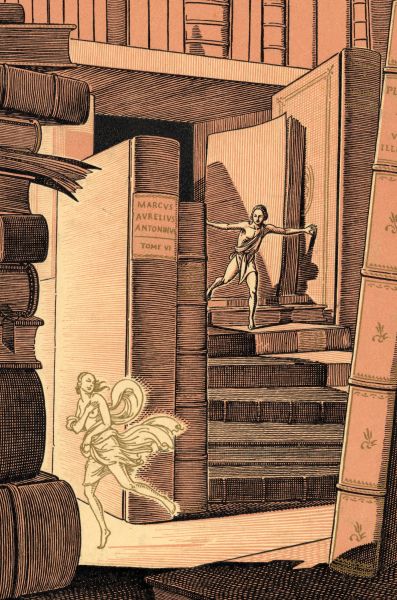
ColophonFor various reasons books occasionally do not make it into a reader’s hands; and so the book that might-have-been acquires a sort of mystique. “A lost book,” writes Stuart Kelly in The Book of Lost Books: An Incomplete History of All the Great Books You’ll Never Read (2005), “is susceptible to a degree of wish fulfillment. The lost book, like the person you never dared asked to the dance, becomes infinitely more alluring simply because it can be perfect only in the imagination.” The simplest form of loss, notes Kelly, is destruction. An infamous example is the legendary Library of Alexandria, supposedly holding all the wisdom of the ancient world, burning to ashes in a single night. Other books are sacrificed to carelessness, as when a certain publisher moved offices, absentmindedly leaving behind manuscripts in a building slated for immediate demolition. Some books never achieve completion because of the death of the author, as when Charles Dickens expired before solving The Mystery of Edwin Drood, or Geoffrey Chaucer reached his eternal destination before his storytelling pilgrims reached their earthly destination in The Canterbury Tales. Often writers simply lose interest in a project. Probably every archive holding printed matter contains unpublished manuscripts.

The Wheaton College Archives & Special Collections houses a few such documents, material undoubtedly meant to be edited, packaged and distributed to the public, but is now foldered neatly in acid-free boxes and shelved in a climate-controlled facility. A brief survey follows:

The second president of Wheaton College, Dr. Charles Blanchard, left for posterity Psychological Foundations, a book-length manuscript discovered as a worn, yellowed roll in the Blanchard home in 1949 by Dr. Clyde Kilby and Miss Julia Blanchard. It advances Blanchard’s observations regarding the development of the “soul life.”

The late Dr. Joe McClatchey (SC-45), professor of English at Wheaton College, wrote The Praise of God in Literature: From Homer to Hopkins, a 400-page study of worship in western literature as seen throughout the centuries.

Jeanne Murray Walker (SC-72), poet, playwright and Professor of English at the University of Delaware, penned a young adult novel entitled Stranger, dated 1989. Though her editors were favorable and encouraged revision, the book was not published.

Academic Arthur Christy (SC-82), recipient of the Guggenheim Fellowship for Intellectual History and American Literature, committed several years to researching The Thoreau Fact Book, reflecting his interest in the New England transcendentalists. It remained unfinished upon his death in 1946.

The brilliant missionary and political professor, Dr. Kenneth Landon (SC-38), husband of Margaret Landon, author of Anna and the King of Siam, composed an unpublished history of Malaya, along with several uncollected short stories, some of which initially appeared in the Saturday Evening Post.

And, among the papers of Madeleine L’Engle (SC-03), author of A Wrinkle in Time, lay several unpublished manuscripts, including sermons, short stories, retreat addresses, a handwritten novel called The Feast of Stephen and a nearly completed novel called A Lost Innocent, featuring Camilla, who first appeared in Camilla Dickinson (1951) and later in A Live Coal in the Sea (1996). Also archived is the text for an illustrated children’s book titled Moses, Prince of Egypt, intended for release with the 1998 DreamWorks animated film.

Though “lost” to the general public, these works are fortunately still available for inspection in Wheaton’s Manuscript Reading Room.

Mary Bent Blanchard

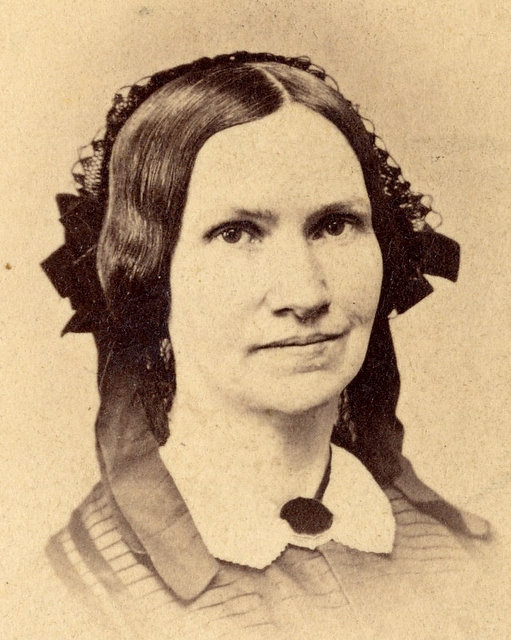
This month marks the 120th anniversary of Mary Bent Blanchard’s death who died on January 11, 1890.

While traveling to California to visit her daughter Sonora Caroline, Mary died at age seventy-one in East Las Vegas, New Mexico. A fuller account is given in Four Hazardous Journeys of the Reverend Jonathan Blanchard by Raymond P. Fischer (grandson of Jonathan and Mary Blanchard).

Another account of Mary’s passing is recorded by Selima Blanchard Allen, Jonathan’s sister. In her diary on Saturday, January 4, 1890, she wrote: “Bro. Jonathan & sis. Mary preparing to go to California, they are very feeble.” On January 6, she noted that “The infirmed state of Bro. & Sister gives us anxiety, but it seemed to be the best they could do: So we have left it all with the Lord.” Her next entry is on January 14 where she wrote that they had received “telegrams & letters, giving account Sister Mary seemed to pass away quietly Pres. C.A. Blanchard started from Peoria to meet his Father.” In following days she provides small details of the wake and funeral.

Malcolm Muggeridge Papers…25 year anniversary

As 2010 finished out it marked the 25th anniversary of the acquisition of Malcolm Muggeridge’s Papers and the 15th anniversary of their dedication . Canon David Winter gave the dedicatory address entitled “Seeing Through The Eye: Muggeridge, the Prophet of the Media Age.” A commemorative booklet including the entire dedication program on November 18, 1995 was made available. The noteworthy event was also featured in a full-page article in the Wheaton’s student newspaper, The Record .

Malcolm Muggeridge, born in 1903, has become one of the notable figures of the twentieth century. He is well-known as an author, journalist, media personality, and in his later years, a leading spokesman for Christianity. Malcolm Muggeridge experienced a life of tension and seeking. Beginning with his socialist upbringing, his father was involved in politics and served as a member of Parliament, his search for satisfaction and justice continued until it culminated in his finally embracing Christianity.

Malcolm was first and foremost a writer and thinker, who contributed greatly to the literature and thought of the twentieth century. As Canon David Winter stated,

The true value of having Malcolm’s papers at Wheaton College comes through being able to preserve “the voice of a craftsman of the English language–and a Christian voice which speaks with all the more splendor because it was born from a seed that was full of doubt, cynicism and self-promotion.

The Papers of Malcolm Muggeridge are available to researchers at the Wheaton College Archives & Special Collections.

For Whom the Bell Tolls

Wendell WhiteThis recollection by Dr. Wendell White ’05 of Los Angeles was submitted to the Wheaton College Alumni Magazine (Feb. 1958) for a feature called “We Asked for Good Old Stories.”

I had returned to Wheaton a week before the school semester commenced. I was downtown in the stores and a Western Union agent got the word and came across the street and told us the startling and tragic news that President McKinley had been assassinated. I jumped on my bicycle and rode up to the college building and over to the Tower as fast as I could make it. I climbed up to where I could reach the bell rope and rang the bell and kept on ringing it. Then to keep anyone from stopping me, I climbed up above the trap door pulling the rope with me and kept on ringing where no one could get to me.

First I saw professor Fischer coming over in his old one horse buggy with his gray horse. Then Professor Whipple came waddling over from the dormitory where they were staying. Soon Professor Straw and Professor Mullenix came. Many people came to the Tower and they tried to stop me from ringing the bell but I only climbed up farther where they couldn’t get through. The trap door was not only closed under my feet but I had to pull a big timber over it. After I had tolled the bell for a long time, I climbed down to where the crowd was waiting to get their hands on me. The moment I saw them I said, “Didn’t you know that the President of the United States has been shot?” And everyone left without a word.