Christians in the Public Schools

As an education professor, I am frequently asked about the three types of educational opportunities: homeschooling, public schools, and private schools—each of which I believe is viable and valuable.
My own experience included a private Christian elementary school, public high school, a private Christian college, and a public university. My children attended public school until they enrolled at Wheaton. Our experiences have been rich and stimulating for academic, social, and spiritual growth. In these settings, we have encountered gifted Christian and non-Christian teachers who challenged our faith by helping us examine what we believe and why we believe it.

When asked to recommend one of these forms of schooling, I encourage parents to examine their own educational views and their child’s characteristics in order to find the best fit. Similarly, when education students ask where to begin their profession, I respond that they need to prayerfully match their educational philosophy with their own God-given personality He calls some to private schools and others to public schools. And often the call changes within a career.

Having offered this advice, I am frequently asked to defend my support of public education. Not only have I attended and taught in public schools, I consider it to be a vital area of service today.

First, the vast diversity in public schools includes both Christian and non-Christian students.While Christian teachers need to demonstrate God’s love to non-Christian families and colleagues, they also offer an important ministry by affirming Christian students for their core belief and values. Respecting every student requires that these individuals’ views be heard in the marketplace of ideas. In caring for all learners, Christian teachers in public schools can provide a model of Christianity in action for a student who might otherwise feel marginalized in a secular world.

Second, public schools offer an opportunity to reflect Christ’s love to students of all economic levels. Christ calls us to meet the needs of the poor. Public schools are increasingly the only option for our poorest students.They (like all students) deserve the most committed and compassionate teachers.

Economic hardship often creates the need for stability. When Steve Mcllrath ’93 began his teaching career at a public high school on Chicago’s west side, his young math students questioned whether he would still be there when they graduated. During his ten years there, Steve has seen nine principals and almost 50 other math teachers come and go (by rhonda). As the epitome of a Christian teacher who serves faithfully in a public school, Steve is much more to me than a former student; he is my hero.

Dr.Jillian Nerhus Lederhouse ’75, Associate Professor of Education, began teaching courses at Wheaton in 1978 while still an elementary teacher in the Chicago public schools. She joined Wheaton’s faculty full-time in 1989 and currently serves as coordinator of the elementary/middle grades program. Recipient of the 2001 Senior Faculty Achievement Award, she has been published in several education journals addressing topics ranging from classroom management to assessment and Christian teachers in public schools. She holds a B.A.from Wheaton, an M. Ed.from DePaul University, and a Ph.D. from University of Illinois at Chicago. She and her husband, Wheaton swimming coach Jon Lederhouse ’74, have three children. (Wheaton Magazine, Winter 2005).

The Invisible PM

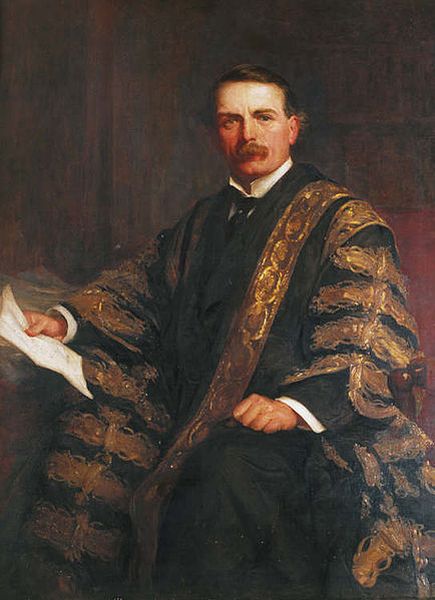
David Lloyd George, 1st Earl Lloyd-George of Dwyfor, was voted the third greatest British Prime Minister of the 20th Century in a recent UK poll. LloydGeorgeAs a Member of Parliament, Chancellor of the Exchequer, Minister of Munitions, Secretary of State for War and tireless social reformer, Lloyd George expertly navigated the political field, winning the hearts of his countrymen.

Visiting the United States in 1923, the “Commoner,” fulfilling a promise, rode the train with other passengers enroute from Chicago to Mooseheart, Illinois, passing through Wheaton, intending to present a speech in the open-air ampitheatre at the famous orphanage. Excited to hear the great statesman, many students from Wheaton College joined the throng at Mooseheart, expecting at least a glimpse of this renowned international guest. Sadly, their hopes were dashed when Llloyd George’s personal physician forbad him from publicly speaking due to health concerns. Instead, he delivered his address on radio in a building which accommodated only a fraction of those who had gathered for the occasion. The former PM returned to Chicago, where he later delivered another address.

Self-Criticism?

“Tell us your impression of the U.S. Is there anything that strikes you?”

As a visitor from “Old Europe,” I am often asked this kind of question. Actually, I have seen very little of the country. I’ve only caught a glimpse, through the Wheaton window.

What I have glimpsed, however, may be worth mentioning. I have been struck by the amount of self-deprecation in current discourse (not within College bounds necessarily), having heard and read a lot of self-critical talk, concerning American ways and values, especially “individualism,” and, in Christian circles, concerning evangelical tradition, or lack of tradition.

Self-criticism is praiseworthy—one hesitates to criticize it! Self-demeaning, to some extent in all cultures, and in some cultures hyperbolically so, it belongs to polite demeanor. It oils the wheels of social exchanges. Since every human group or institution tends toward inflated images of self, often bordering on idolatry, correction is salutary.

Individually and collectively, the ability to acknowledge weaknesses and faults reflects maturity. Combating pride, the ever-present enemy, is always timely-for pride disguises itself as loyalty or gratitude. (Remember the account in Luke 18:9-14. The Pharisee’s thanksgiving met the outward expectation of religious life, and yet, he did not go home justified.) But cannot self-criticism itself become a disguise? When we criticize our tradition, don’t we secretly feel that we thereby raise ourselves above what we censure?

We say “we,” and mean “they.” Of course, I realize that this boomerangs on me just now. Intellectuals in our societies, as they disparage established orders, often vent their frustration and resentment for not wielding power. (Nietzsche was not wrong on all counts.) Blaming the status quo, of which one is a part, relieves hidden anguish and projects the subject’s existential discomfort onto the world. An upcoming generation conveniently makes room for their own ambitions, brushing predecessors to the side. Not waiving their claim on the estate, they become “self” critical. In any case, as a general phenomenon of perception, attention is always drawn to what does not work properly, thus fostering exclusively negative assessments, and failing to honor that which is praiseworthy.

What are the marks of sound self-criticism? Balance and nuances, and recognizing that which is valuable and must be maintained—these are hopeful signs. Slogans or catchwords, conformity to fashions, ready-made generalizations, are all red signals. Critics are open to suspicion that keep enjoying the benefits of what they condemn. If it is truly self-criticism, it will entail some concrete steps of action.

The heart, however, is so crooked, “deceitful above all things,” that discernment ultimately belongs to the Lord, the Lord alone (Jer. 17:9). His Word is the “critical” (kritikos) agent, to which only we will turn for true and healing criticism (Heb. 4:12).

Dr. Henri A. Blocher, Wheaton’s Gunther Knoedler Chair of Bible and Theology, was born a Frenchman in Leiden, Netherlands. He studied at Gordon Divinity School and in Paris and London. He has taught in the Faculté Libre de Théologie Evangélique, Vaux-sur-Seine, since its founding in 1965, and currently chairs the Fellowship of European Evangelical Theologians. His books include In the Beginning, Evil and the Cross, and Original Sin. He and his wife, Henriette, a psychologist, have three children and seven grandchildren. (Wheaton Magazine, Autumn 2004).


Minding the Mind

I love maps I can spend hours poring over the details of a terrain that I have never seen and probably never will see. So when I travel somewhere, I am not content with a generalized map of the area; nothing less than a Delorme atlas with every gravel road marked will do.

How nice it would be to have such a detailed map of our spiritual pilgrimage—to have every decision clearly marked and the road for years ahead clear and straight. Some Christians try to get that kind of information out of their Bibles. They search for verses that will tell them what job to take, whom to marry, what school to attend. Of course, they are doomed to be disappointed—or worse yet, to think God is giving them specific direction in a verse that means nothing of the kind. Other Christians simply give up: since God has not told me anywhere what job I should take or what school to go to, it does not matter what I decide.

Both these responses miss the true nature of God’s guidance of us through Scripture. God has not given us a Delorme spiritual map revealing every twist and turn of our lives What He has given us instead is a revelation of Himself. Who He is, what He has done, is doing, and will do, and what He values most in His people.

By reading, studying, and meditating on this revelation, we find our very worldview being changed. Paul describes this process in his famous call for Christians to “renew their minds” (Rom. 12:2; Eph. 4:23). It is by this transformation of our fundamental attitudes and values that we will be able to “test and approve what God’s will is” (Rom. 12:2). God desires that we so immerse ourselves in Scripture that its values gradually become our values. These values, built deeply into us, will then guide us in all the decisions of life.

As my wife and I raised five children (now all grown), we were especially anxious to help them develop these renewed minds. We were not so concerned about whether they would agree with us on every lifestyle decision that we made. But we wanted them to make their own lifestyle decisions, not on the basis of the materialistic cultural values of this world, but on the basis of solidly biblical values.

I have a similar vision for the students I teach at Wheaton College. My goal is to expose them to Scripture in such a way that the very roots of their minds will be thoroughly Christian. For if, by God’s Spirit, their minds are being so transformed, I can be confident that they will emerge as strong examples of righteousness in a world that desperately needs such a witness.

Dr. Douglas J. Moo is Blanchard Professor of New Testament and Director of the Ph.D. Program in Biblical and Theological Studies. A relative newcomer to Wheaton, Doug arrived in 2000 after a long ministry at Trinity Evangelical Divinity School in Deerfield, Illinois. He holds a B.A. from DePauw, an M.Div. from Trinity Evangelical Divinity School, and a Ph.D. from St. Andrews in Scotland He and his wife Jenny live in West Chicago. Three of their children have attended, or are attending Wheaton College. (Wheaton Magazine, Winter 2004).


Ageless Wrinkle

WrinkleThe editors of Amazon released in 2014 their selections for “100 Books to Read in a Lifetime.” Placing sixth is A Wrinkle in Time by Madeleine L’Engle. The Newberry Award Winning classic celebrated its 50th anniversary in 2012.

Other choices include 1984 by George Orwell, Alice in Wonderland by Lewis Carroll, Me Talk Pretty One Day by David Sedaris, Slaughterhouse Five by Kurt Vonnegut, Where the Wild Things Are by Maurice Sendak and The Shining by Stephen King.

The original manuscript for A Wrinkle in Time is housed at the De Grummond Children’s Literature Collection at Hattiesburg, Mississippi; but L’Engle’s remaining correspondence, artwork and manuscripts (SC-03), including the remaining titles of the The Time Quartet, is housed at Wheaton College (IL) Special Collections.

Expanding Horizons

At the request of President Duane Litfin, an Arts Task Force is considering the place of the arts at Wheaton. While Dean George Arasimowicz puts the finishing touches on the first report, we continue to address unimaginable changes in the arts—changes we are trying to take stock of when we consider the trajectory of arts education at a world-class undergraduate institution.
So what has changed? This is no surprise, but technology has changed. Plans are under way for new sound, lights, and a projection system for Edman Chapel. Conservatory faculty members are already gearing up to use this system to project subtitles of text- based music performances. We will use it to lead congregational song (words with music, if I have anything to say about it). We will use it to reintroduce visual art to worship. And we will use it to communicate with Wheaton friends in the far corners of the world through the Web.

Then, the Chicago Tribune recently published an article titled “The Spirit Moves Them.” The subtitle reads, “Sacred dance troupes transcend the boundaries of worship.” I’ll never forget my experience with movement at a worship conference in Berlin several years ago. The Praise Dance Ministry of Friendship-West Baptist Church, Dallas, danced to a song called “Total Praise.” The African-American church is taking the lead in this area. And movement is just one art form among many being used in the quest for authentic, intimate worship.

Attitudes have changed, too. My son Patrick, a Wheaton College freshman, is one example. Pat wants to be a filmmaker. He’s exploring films as diverse as Babette’s Feast and Traffic. In Berlin, the only thing he wanted to see was the Picasso exhibit. His tastes in music range from Shostakovich to Smashing Pumpkins. At the theater, it’s Shakespeare. He wouldn’t think of limiting his engagement with the arts to one stylistic or technical portal. The world of the arts is just too rich and diverse. And Patrick isn’t so unusual.

Have you heard the latest recording by banjo virtuoso Bela Reck? It’s called Perpetual Motion—a recording of collaborations with the great violinist Joshua Bell, marimbist Evelyn Glennie, and others. No, it’s not bluegrass—this time—but intelligent, artistic transcriptions of standard works by classical composers. Then there’s Ben Heppner, arguably one of the greatest dramatic tenors of our time. Ben and I sat at dinner one evening last fall with our vocal studies chair, Carolyn Hart, and reminisced about the old John W. Peterson cantatas we sang during our formative years.

I want to let you in on a little secret. In a way, I wish music study at Wheaton could be done from an observatory instead of a Conservatory. Our students and faculty are involved in so many exciting things. Keyboard Chair William Phemister is devising a graduate degree in arts ministry. Gerard Sundberg sang the Messiah with the Atlanta Symphony Orchestra last December (by tomoson). Lee Joiner, Kathleen Kastner ’71, Curtis Funk, and Howard Whitaker ’63 participated in the inaugural season of the International Improvisation Institute, collaborating with Ken Medema, Charlie Peacock, Jake Armerding ’00, and others.

I just told a student this morning that it’s a great time to work in the arts. Our culture is receptive to the arts. And the church is poised, more than at any time in recent history, to use the arts for Christ and His kingdom. This is why we are so excited to be expanding our arts horizons.

—–
Tony Payne ’79 is director of the Conservatory of Music and associate professor of music. He holds degrees from Wheaton (B.Mus.), Bowling Green State (N.Mus.), and Northwestern University (D.M.A.). Recent compositions include “Hold on to Hope” (Carl Fischer CM4689), and a new setting of “Give Thanks to God on High” for the Wheaton College Men’s Glee Club. The LIttle Match Girl was most recently staged in 1999. He has been a co-editor of two cross-cultural hymnbooks and has written dozens of songs and hymns. (Wheaton Magazine, Winter 2002)


Dayuma

b11495
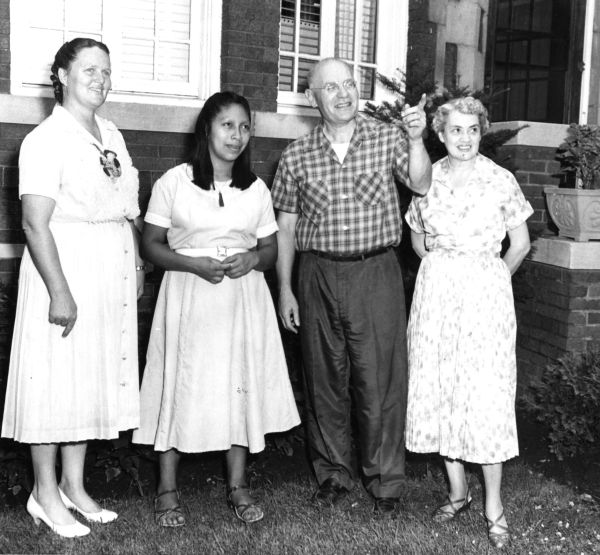
l to r: Rachel Saint, Dayuma, President and Mrs. V. Raymond Edman

Dayuma, born and raised amid the daily brutalities of the Waodani tribe of Ecuador, died on March 1, 2014, entering “gates of splendor” as the result of missionary work initiated by Jim Elliot and Nate Saint. After her conversion, she traveled throughout the United States, speaking about evangelism and reconciliation.She was baptized in 1961 by Wheaton College President V. Raymond Edman at Evangelical Free Church of Wheaton. She presented to Edman three Waodani spears, now housed in the Wheaton College Archives.

Assisted by missionary Rachel Saint, she eventually brought many of her family and friends to saving faith, consequently reducing the murder rate among her tribe by 90%.

The story of martyrs Nate Saint, Jim Elliot, Peter Fleming, Roger Youderian and Ed McCully is told in Through Gates of Splendor by Elisabeth Elliot.

The Church and the Formation of Christians

I love the church. And the older I get, the more I value it. That affection is longstanding because I loved the church even as a child.

I grew up in Omaha, Nebraska, where my family had founded what became a large congregation. I was as at home in that church as I was in the house where I lived. The people there were like family. I was shaped by their stories and views of God.

My devotion to the church is deep and irrevocable. My soul rejoices when the whole family of God comes together to glorify our Lord—to “put God on display,” as J.I. Packer stated in this year’s commencement address. But there is another side to my view of the church. I am concerned, even frustrated, by some of what we do to each other in the name of church life—such as separating people by age, even during worship. Quoting Packer again, this happens because we are “pygmies and invalids” when it comes to seeing God’s greatness and holiness. We fall short of God’s desire and are unaware how truly broken we are as we exchange our biblical identity for cultural relevancy.

Some evangelical churches segregate church life and systematize ministries in ways that now seem normative, virtually eliminating the need for careful biblical critique. Does Scripture say anything about how God’s people should gather? If so, is it relevant for today? I wonder if in our desire to be “developmentally appropriate;” we evangelicals miss some of our Father’s intent for us, His church. Because I teach courses concerning church ministries, I’m able to focus on these issues.

Two years ago the department in which I teach changed its name from Christian Education and Ministry to Christian Formation and Ministry. The more I reflect on this change, the more significant it becomes. The word educate comes with expectations familiar to most: classroom, teacher, students, content. The word formation is different—less familiar, fewer assumptions. It requires pro ass in shaping product. It’s more like “May Christ be formed in you” (Gal. 4:19) rather than “Let me teach you about God.” I’m challenged to alter courses in light of this change.

I must read Scripture with formation in mind—my own, first of all, and then that of others. The opening verses of 1 John excite me. As Eugene Peterson translates them,”… [We] heard it with our own ears, saw it with our own eyes, verified it with our own hands. The Word of Life appeared right before our eyes; we saw it happen! …We saw it, we heard it, and now we’re telling you so you can experience it along with us, this experience of communion with the Father and his Son, Jesus Christ.” Our faith has a sensory dimension—one that can be experienced.

This calls for encounters with the living God. Is that a formational task or an educational one or both? In what ways can the ministries of the local church enable encounters with God through the Holy Spirit? Where do North American churches look for ministry models? Are there principles in Scripture that we overlook or disregard that we should recover, so our faith may be passed on more effectively to the next generation? Because I too am a pygmy and invalid, I humbly acknowledge my need for our Lord’s grace and mercy as I explore ways in which formation happens.

———-
Scottie May has been an Assistant Professor in the Department of Christian Formation and Ministry since 1998. She has a doctorate in education from Trinity Evangelical Divinity School. Her primary research focuses on how children come to faith. Other areas of interest are the effectiveness of ministry learning environments, ways children encounter God, intergenerational worship, and the church as “the family of God.” Scottie has three children and six grandchildren. She and her husband, Robert, live in West Chicago, Illinois. (The above statement was included at the time of publication — Wheaton Magazine, Summer 2001).

Looking to the God of Peace

Chaplain Stephen B. Kellough

Since September 11 there has been a lot on my mind, and there has been a heaviness on my shoulders that is associated with the privilege and responsibility of serving as Wheaton’s chaplain in these days.

For this generation of students, the charged atmosphere brought about by catastrophic world events is unprecedented. Columbine comes closest, and maybe Oklahoma City. But Vietnam and even the Gulf War are off the radar screen for most students. Korea and Pearl Harbor are ancient history. For that matter, even those of us on the faculty and staff at the College have never faced the kind of assault on American turf that we have witnessed.

During these difficult moments, we are finding that the resources of our Christian faith and the value of living in Christian community are becoming near and dear. Wheaton College is a good place to be right now, even for students who are many hours from home.

Shortly after the hijacked planes hit the World Trade Center and the Pentagon, a special chapel service was called for the College community. Within hours of the attacks, students, faculty, and staff were assembled in Edman Chapel reading Scripture and praying to our heavenly Father. We were together in worship when we needed to hear from God and to speak to God.

Classes were not dismissed on September 11, and that was a good decision. But we followed the news reports on televisions around campus, and phone calls were made to family and friends. Caring faculty assisted students in processing the events that were shaking our world, and don’t think that students didn’t minister to professors as well. We were together in community, trying to understand, assisting each other in struggling to focus the lens of our Christian worldview on the events of the day.

As most Wheaton alumni remember, it is our tradition to designate a passage of Scripture as a “year verse.” The verse for the 2001-02 academic year is Hebrews 13:20-21, the words of a blessing, a benediction that reminds us of our position in Christ and our resources in God: “May the God of peace, who through the blood of the eternal covenant brought back from the dead our Lord Jesus, that great Shepherd of the sheep, equip you with everything good for doing his will, and may he work in us what is pleasing to him, through Jesus Christ, to whom be glory for ever and ever. Amen.”

Little did we realize months ago when this text was chosen that we would be in such need of this reminder of our resources in the God of peace. The letter to the Hebrews was written to people of faith whose faith was being tested. They needed to be reminded of what they knew but what they were struggling to hold on to.

The letter to the Hebrews is more than a letter; it is a sermon. It’s an encouragement, and it’s a reminder. In my role as chaplain, that is my goal—to encourage and to remind. In these days it is my duty and delight to point our community to the God of peace. This is a title for our Lord that we need to savor right now. In the midst of very uncertain times, it is important for us to understand with our minds and to embrace with our hearts the God of peace and the peace that God gives.

Wheaton Magazine (Autumn 2001)

Apostles of Reason

WorthenMolly Worthen, Assistant Professor of History at the University of North Carolina, Chapel Hill, using the combined resources of Wheaton College’s Archives & Special Collections, Billy Graham Center Archives and the Wade Center, has released Apostles of Reason: The Crisis of Authority in American Evangelicalism (2014). Navigating the paradoxes and ideological clashes of the Christian Right with American culture, she examines the often fierce struggle between faith and reason.

Historian Mark Noll, formerly of Wheaton College, remarks: “Apostles of Reason brings a new level of sophistication, as well as sparking prose, to the study of modern American evangelicals. A combination of empathetic understanding and critical acumen makes this an unusually humane, as well as unusually insightful, book.”