Abundant Life

The Energizer Bunny advertising campaign proved to be a success partly for its novelty and also for its implication that if we use the correct battery, we would never run out of energy to operate small appliances.

But the actual never-ending feature of our daily lives is the reality that our resources are limited. We do not have enough time, money, energy, or talent to achieve all that we desire. Some of the most nettlesome ethical choices facing our world are the result of limited resources, such as the availability of oil, medical aid, and fertile land; or the supply of courage, wisdom, and trust.

Acknowledging the limitation of resources is not difficult for the believer, for we know that our world—and its provisions—is under the temporary rule of death. In death we face the ultimate threat to our plans and dreams. We struggle with limitations because death has stained every facet of creation.

With Paul we may cry, “Who will rescue me from this body of death?” (Rom. 7:24). Or with Moses we may pray, “Relent, O Lord! How long will it be? Have compassion on your servants” (Ps. 90:13). In Christ alone we find the promise of life outside the rule of death. After that poignant question in Romans 7:24, Paul describes how Christ sets us “free from the law of sin and death” (8:2). Our new life is a reception of life indeed, the freedom to live with the resources not of this deathly world, but of God Himself.

Moses answers his own urgent plea by recognizing that God is the source of abundance: “Satisfy us in the morning with your unfailing love, that we may sing for joy and be glad all our days” (Ps. 90:14). God’s love does not operate on the principle of scarcity, and the rule of death does not limit the resources of His charity.

Only if we understand the abundance of God’s grace can we begin to understand Christ’s remarkable instruction that we forgive not just seven times, but seventy times seven. We ought to treat others not out of our limited resources, as if our capacity to forgive others can be depleted, but out of God’s abundance, through which we can forgive over and over and over again. Only a life lived within God’s abundance can accomplish Christ’s instructions: “And if someone wants to sue you and take your tunic, let him have your cloak as well. If someone forces you to go one mile, go with him two miles. Give to the one who asks you, and do not turn away from the one who wants to borrow from you” (Mt. 5:40-42). This is the practice of abundant life, not the rule of death.

Because of God’s abundance, Christians are to be known for their giving, their caring, and their hospitality. Oxford theologian Oliver O’Donovan notes the provocative nature of Christian generosity: “An extravagant, unmeasured goodness, corresponding to God’s own providential care, defies the logic of public expectation” (The Desire of the Nations 109). We ought to defy the logic of this world, and lives rooted in God’s giving are capable of just that.

Through my research on communication practices, I now believe that our ways of talking and listening can be rooted in life or in death. Are we cynical, measuring the talk of others according to the waste of limited resources, or are we charitable, looking with grace upon the efforts of others? Do we persuade others by appealing to their fears of loss or their hopes of gaining scarce rewards? Or do we urge others to lives of trust, charity, and generosity?

We still must struggle in a world ruled by death. Perhaps, the greatest benefit of God’s abundance is the never-depleted supply of wisdom He gives us to see our difficult decisions from the vantage point of abundant life, We are free to rest in a limitless God.

Dr. Kenneth R. Chase, Associate Professor of Communications, came to Wheaton in 1994 after teaching full-time at Wabash College, and in other various capacities at Biola University, Illinois Wesleyan, and University of Illinois. His research in ethics, public address, and popular culture will be invaluable as he assumes additional responsibilities in the fall as director of Wheaton’s Center for Applied Christian Ethics. He and his wife, Linda, live in Wheaton with their three children. (The above statement was included at the time of publication — Wheaton Magazine, Spring 1998)

From “For Christ and His Kingdom” to the Magic Kingdom

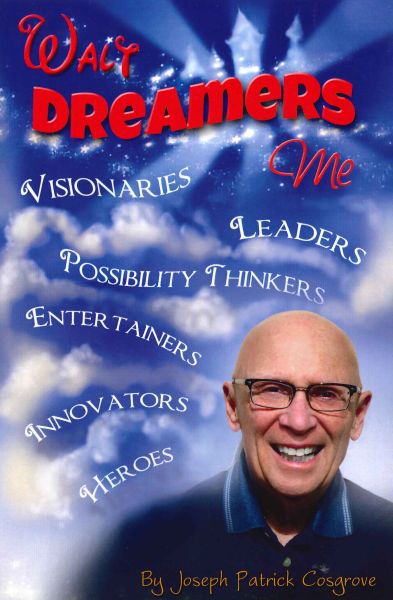
CosgroveNo common book cites among its Acknowledgements celebrities such as Walt Disney, Bob Hope, Steve Allen and Jack LaLanne along with theologian E.J. Carnell and evangelist Charles E. Fuller, but Joseph Patrick Cosgrove (’54), producer, director and broadcaster, happily thanks  these and others in his memoir, Walt Dreamers Me (2013), for contributing to the rich diversity of his life.

Originally from Boston, Cosgrove includes a few entries about his days at Wheaton College. A sampling:

Arrival – Wheaton College. With a letter of recommendation from Dr. Ockenga, I am off to Wheaton College, Wheaton, Illinois. I am the only one from my neighborhood seeking higher education. I am now on my journey of life and closer to my goal of going to California.

Overwhelmed College Daze. Taking a full load of classes and working full time to pay tuition overwhelms me and I withdraw from Wheaton at the end of six weeks and return to Boston. As I meet with my pastor, Dr. Harold Ockenga, I am convinced to return to Wheaton after only one missing week. Dr. Ockenga personally pays for my first semester and arranges with the college Dean for my return to college life. Dr. Ockenga has become a father figure to me. There is no going back to Boston. I am off and running and work long hours through each summer and spring break to pay my living expenses as well as my tuition and books.

The Learned Campus Lessons. Living in a college dormitory and attending college class is a challenge for me. Daily chapel is mandatory at Wheaton College in 1950. Wheaton is a well-known and conservative evangelical institution with a reputation for high scholarship. I learn as much working in factories and doing construction work as I do in the classroom. Students at Wheaton must sign a pledge not to dance, play cards, smoke, gamble or attend the theater, opera or stage plays. I sign because I do not have the time or money to do these things anyway. Because I saw firsthand what alcohol did to my father, I do not drink or smoke.

Christmas Comes in October. As Head Cheerleader I decide to celebrate Christmas in October. The City of Wheaton decides to let me borrow city Christmas decorations. Overnight the Wheaton College campus is decorated with Santa Claus and his reindeer. Music of the season, from “White Christmas” to “Santa Claus is Coming to Town,” as recorded by Bing Crosby and the Andrews sisters, rocks the campus the next day. I am called to the Dean’s office to explain myself. The Dean is a bit rattled by my antics but the campus cheers me.

California: Here Comes Joe! In the fall of 1954, I began classes at Fuller Theological Seminary, Pasadena, California. Founded in 1947 by media pioneer Charles E. Fuller and Dr. Harold John Ockenga, Fuller Seminary is an innovative and inclusive graduate school situated in the heart of downtown Pasadena. Dr. Ockenga is featured speaker at my graduation at Wheaton College and afterward he enrolls me for the Fall Semester at Fuller Seminary. I find graduate school a real challenge compared to college.

Settling in California, he begins his career as a broadcaster and occasional employee of Disney, while also campaigning for Ronald Reagan and Barry Goldwater. He also directs and produces fitness guru Jack LaLanne’s first media kit and “Jack’s Big Swim for Fitness.”

Summing up his life lessons, Cosgrove writes: 1) Follow your dreams. 2) Keep focused doing it. 3) Use your imagination and fantasy to create your vision. 4) Be optimistic. 5) Keep learning something new. 6) Be open minded. 7) Team up with talented people of like minds and attitudes. 8) Engage and entertain others through storytelling and music.


Campus Cakewalk

b9071Wheaton College enjoys a tradition of self-referentially “doing up” its landmarks as tempting refreshments, usually presented at ceremonies or celebrations.

For instance, this cake, a replica of the newly constructed Memorial Student Student Center, was served at the grand opening in 1951. The ribbon was cut by Mrs. J.G. Read, mother of Gold Star son Lt. Glenn Read, a Flying Fortress Navigator reported missing over the English Channel during WWII. The first slice was extracted by Glenn Heck, Student Council Chairman. 1500 guests attended the open house.

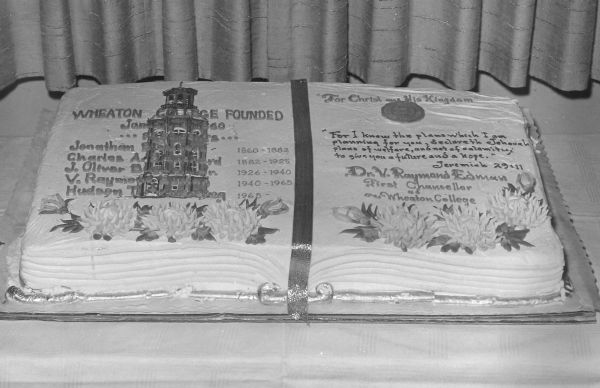
A few years later this appealing sheet cake, shaped like an open Bible, was served at the 1965 inauguration of Dr. Hudson Armerding, fifth president of Wheaton College. The previous presidents and their administrative tenures are cited in the frosting, along with an illustration of the iconic limestone Tower from Blanchard Hall. a11336

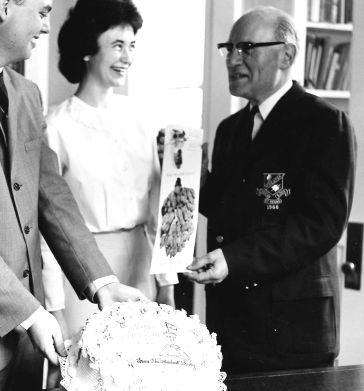
a10621Dr. V. Raymond Edman, former president of Wheaton College, now serving as Chancellor, was treated to this birthday cake in 1966, presented by the student body. The greeting inscribed in frosting reads, “Happy Birthday, Prexy,” next to yet another representation of the Tower, a flag waving atop.

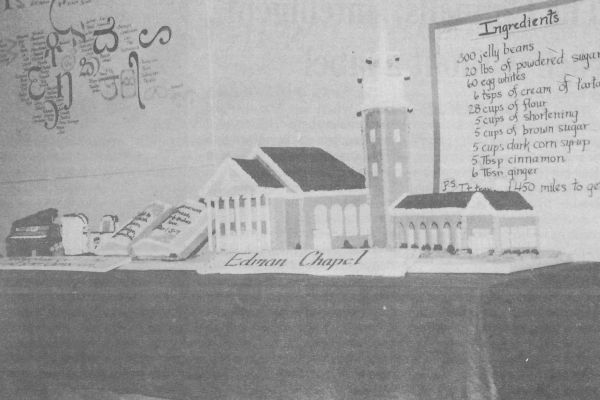
Below, this impressive gingerbread Edman Chapel was created by twins Kay and Karen Chamberlain, who displayed it in the lobby of the Memorial Student Chapel in 1992. Accompanying the display is a list of ingredients.

gingerbread

Blanchard Hall appears again as a magnificent gingerbread house in a 2013 Wheaton College promotional video, featuring Dr. Philip Ryken and family (including Miss Karoline Ryken, pictured) at Christmas. image1


Doing & Being

I have always enjoyed being outside—as a little girl swaying in the tops of evergreens while hiding from my siblings, or lying in sweet-smelling grass looking for shapes in the summer clouds. I visit past moments often in my heart—times when I walked near the ocean that my soul became closely attuned to hearing myself think and God speak.

Some folks believe they have to be “earthy” to deeply appreciate Creation. Not so. We all desperately need the healing balm of nature—a display that can calm and simplify our lives while drawing us nearer to our Creator.

Henri Nouwen suggests in his books The Way of the Heart and Out of Solitude, that we are often motivated by the compulsions of society to measure our self-worth by the many things we can accomplish—some of which are not as necessary as we might think.

I struggle with this compulsion. Yet God’s Creation teaches me about the tension between “being” and “doing.” All things created by God display his glory by simply being what God created them to be. And so, I find myself longing for times of solitude—times of throwing pottery, walking in a park, visiting the ocean bottom, admiring the trees outside my office window, or watching spiders jump along my windowsill.

Nouwen points out that when we let society define us, we take on “false selves.” We get caught up by selfish ambition, doing things that are prestigious and pleasing to our peers, and—so we think—to God. Sometimes in our Christian duty we get the doing part confused with the being part. We think of the things we are to do that will bring him glory more so than what we are to be.

The relationship between being and doing became clearer to me as I related to my sister, Rob, throughout her battle with cancer. Before her illness, I was much better at doing the work of my career than in being there for those who needed me, So, naturally Rob found it difficult to believe that I really cared deeply for her because my work took up so much of my life.

After I turned down two permanent job offers so I could live near her and later took a job in Minnesota near her home, she was finally able to fully realize my love for her.

But more importantly, God began to communicate his love for her through me. Rob eventually moved to Virginia to live with my older sister, Sandy, and I later chose to go there to be with Rob during her last months of life.

During my sister’s battle with cancer, God taught me a lot about the difference between being and doing. I learned what it meant to be myself, to be what God had intended me to be—a channel of his love and grace for Rob. This may not seem like a profound revelation, but it is important for all of us to be reminded that it is not what we do that is most important, but rather what we end up being or becoming.

There is a balance, of course. But God calls us to be his people, to be people who are in close communion with him, and to be our true selves, human beings created in his image to bring glory to him.

The following statement was included at the time of publication (Wheaton Magazine, Summer 1997)

Dr. Nadine Folino, Assistant Professor of Biology earned a bachelor’s degree in biology from the University of Cincinnati, and master’s and Ph.D. degrees in zoology from the University of New Hampshire. She is an enthusiastic marine biologist specializing in invertebrate zoology. Her hobbies include pottety, sports of all kinds biking, skiing, and running-cooking, and camping. Dr. Folino enjoys Creation greatly seeing God’s creativeness expressed in all of earth’s many and varied “critters.”

Out with the Old

Natural studies had long been featured in the Wheaton College curriculum, but the ever-increasing interest in science indicated to the administration that a modern facility was needed to house the biology, physics and mathematics departments. The proposed structure would adjoin the existing Breyer chemistry building, and would include 20 faculty offices, six class rooms, 14 instructional laboratories, 15 faculty or student research labs and a reference room for housing specialized journals and handbooks representing all the sciences. It would also feature an exhibit hall for the recently acquired Perry Mastodon, displayed in a glass enclosure facing the quadrangle lawn. This plan, designed in Georgian style, was initially proposed: SB1

After further discussion, the plan was revised, prompted by economic factors, provision of additional space, the possibility of future expansion and the desire for a more contemporary motif. Like the previous plan, this design allowed for a telescope and observatory on its roof. Groundbreaking began on June 1, 1969. Armerding Science Building (below) opened in 1971 and served admirably for the next thirty-nine years until the state-of-the-art Meyer Science Center opened in 2010.SB2


Sweet Smelling Savor

The delicacy and sweetness of fragrance is enticing. Fragrant scents, whether floating in the breezes of meadows or crushed into oil or other compounds, add, through their signature aromas, variety and fascination to our lives. A summer walk through flowers in high meadows, a stroll through a pine forest in early winter, or a visit to a greenhouse of orchids shortly before Easter can spark our imaginations and stir waves of nostalgia. In contrast to those pleasant fragrances, however, there are also unpleasant odors whose characteristic aura we find distinctly offensive.

Substances that emit fragrance played an important role in the Old Testament sacrificial rites. The sacrifice was the central feature of worship for God’s people as they approached His holy presence. As we read Old Testament scriptures, we see the call for daily sacrificial offerings in order to atone for sin (Lev. 1:4). The sacrificial animal was slaughtered, and its blood atoned for sin.The aroma of the sacrifices that were consumed on the altar was a sweet smell, pleasing to the Lord (Lev. 1:9,13,17 NIV).

These paradoxical images of destruction and acceptability in God’s sight appear in the most compelling prophetic passage that points to the atoning work of the Great Sacrifice, Jesus Christ. “Surely he took up our infirmities and carried our sorrows, yet we considered him stricken by God, smitten by him, and afflicted. But he was pierced for our transgressions, he was crushed for our iniquities; the punishment that brought us peace was upon him, and by his wounds we are healed. We all, like sheep, have gone astray, each of us has turned to his own way; and the Lord has laid on him the iniquity of us all” (Isa. 53:4-6). “For he bore the sin of many, and made intercession for the transgressors” (Isa. 53:12).

These Old Testament institutions and the prophetic voice all found their complete fulfillment in the atoning work of Christ. He was both sacrifice and high priest (Hebrews 9). Further, His resurrection means that the finality of death has been removed from us and we can anticipate living forever with Him. It is the culmination of the glory of Christian hope, and as adoptees, we have been promised inheritance, which is beyond our greatest imagination—we will share in the glory of Christ forever—a sweet fragrance indeed.

I am intrigued by the Apostle Paul’s use of this imagery in 2 Corinthians 2:14- 16: “Thanks be to God, who always leads us in triumphal procession in Christ and through us spreads everywhere the fragrance of the knowledge of him. For we are to God the aroma of Christ among those who are being saved and those who are perishing. To the one we are the smell of death; to the other, the fragrance of life.”

God has prepared us to be vessels through which the fragrance of Christ, notably the knowledge of Him, is spread. Just as fragrance diffuses from its source with differing degrees of intensity, so also we, each as a unique creation of God, are called to spread that precious fragrance in our own ways. The Lord Jesus shapes our beliefs, behavior, and character. Our confidence rests in Christ and the message of His transforming work, and, as a sweet savor, these are pervasive.

Paul points to the saved in Christ and then to those who are perishing. The fragrance that we bring in the gospel message is life-giving to the former but to the latter is a deadly smell. It is our challenge to make certain that we do not allow the subtle temptations of the world to pollute the savor but instead remain dedicated to serving with justice, mercy, and humility.

The following statement was included at the time of publication (Wheaton Magazine, Winter 2001)

Dr. Dorothy F. Chappell, Dean of Natural and Social Sciences, is deeply committed to Christian higher education and served on the faculty of Wheaton College for 17 years. Following a five-and-a-half-year term as academic dean at Gordon College and serving on Wheaton’s Board of Trustees, she is now in her second year of full-time administrative duties at Wheaton. She has received awards for research and teaching and has interests in the biochemistry and ultrastructure of green algae; ethics; and Christian faculty scholarship.

Christmas Greetings from Prexy Edman

PrexyXmasThe December, 1961, Wheaton Alumni magazine features on its cover a photo of President and Mrs. Edman sitting cozily before a blazing holiday hearth, probably at their home, Westgate.

(Or perhaps it is a cold fireplace with a lantern placed within, since there does not seem to be an actual fire.)

The caption reads, “We asked ‘Prexy’ and ‘Friend Wife’ to carry to you our greetings for Christmas and the New Year ‘For Christ and His kingdom.'”

Fulfilling the Two Tasks

Twenty years ago this fall, as a new Wheaton freshman, I sat with hundreds of others on the lawn of front campus to witness the dedication of the Billy Graham Center. Sharing the platform with Dr. Graham ’43 and President Hudson Armerding ’41 was the keynote speaker, Charles Malik, a Lebanese educator and statesman whose words profoundly changed my attitudes toward learning and the gospel. Malik’s central argument was that Christians in general and North American evangelicals in particular stood little chance of having a deep impact upon their society unless they proved able to know and influence the intellectual life of the world. We are, he contended, admonished to save both the soul and the mind.

The speech found such resonance in the College community that it was quickly published in pamphlet form as The Two Tasks. Malik’s words, together with my subsequent four years at Wheaton, helped me begin to see past my dualistic and utilitarian views of evangelism and education.

While working with evangelical student groups in the city of Munich in the late ’80s, I found that Christian students in Germany also had a strong desire to view their studies from within the context of their faith. But my German friends wondered how they could ever hope to think as Christians or share the gospel with their peers when they could barely see past the boundaries of their own disciplines.

Wheaton has long valued the integration of faith and learning and the wholeness of a liberal arts education. Since joining the faculty four years ago, I’ve been a part of two initiatives geared toward helping students and professors work more effectively at the two tasks envisioned by Malik.

The first is Freshman Experience, a required course in which students explore such issues as consumerism, forming a Christian worldview and the theology of work and leisure. Above all, Freshman Experience mentors aim to get students excited about being students, to encourage them to see their studies and other activities not just as means to an end, but as part of the work of the kingdom. Not surprisingly, The Two Tasks occupies an important place in the syllabus.

During the 1999-2000 academic year, I benefited from the second initiative: the new faculty Faith and Learning seminar, which might be considered the postdoctoral equivalent of Freshman Experience. Our eclectic group (representing 11 departments) discussed topics ranging from biblical ethics, to Christology, to ways of knowing. It was inspiring to see that God had called such different people to pursue scholarship in a single Christian academic community. Though there was ample disagreement, we were united in our desire to think, speak, and live as new creations in Christ.

How well is Wheaton carrying out the two tasks that were laid upon us two decades ago? My experiences in the classroom and the seminar room over the past year give me reasons to be optimistic. I’ve observed colleagues and students striving to love God with all their hearts, souls, and minds. In my own teaching and scholarship, whether it be analyzing the roles of prayer and providence in a recent German film or outlining cultural differences in a Business German course, I’ve found that true joy comes in pursuing both of the two tasks wholeheartedly.

The following statement was included at the time of publication (Wheaton Magazine, Summer 2000)

Dr. Clint Shaffer ’84 is an assistant professor in the department of foreign languages and director of the Wheaton in Germany program. He received his M.A. from Middlebury College and his doctorate from the University of North Carolina at Chapel Hill. His scholarly presentations and publications deal with 18th- and 20th- century literature, German cinema, and foreign language pedagogy. His current research is a study of Christian responses to Asian religions during the German Enlightenment. He and his wife, Virginia Davidson Shaffer ’84, are the parents of Bill (5) and Sarah (3), and enjoy introducing Freshman Experience students to Chicago-style pizza.

Loving our Enemies

by Sarah Borden (Wheaton Alumni Magazine, Autumn 2003)

Today’s a high alert day in New York. I have been spending a few days in the Bronx with friends, and last night came back on the commuter train after dinner down in Manhattan. At a quarter before midnight, Grand Central Station was filled with National Guard men and women, dressed in camouflage and carrying large machine guns. I have certainly seen guards with guns stoically surveying a crowd, but, previously, they were in other countries and at the borders of other lands. Now they stand in our train stations, at our borders and airports.

Headed home that night, I realize that I increasingly find myself asking what it means to love our enemies. How, concretely, are we to be a neighbor to those who hate us? Jesus clearly asks us to pray for our enemies, and surely this includes asking God to convert the hearts and save the souls of Osama bin Laden and the members of Al Qaeda. But are we called to even more?

Consider the language that we use in describing our enemies. I admire President Bush’s concern for what is moral; he has strong and courageous convictions regarding good and evil.

But there is also a danger in calling any particular person evil. In calling someone “evil,” we run the risk of painting her as fully irrational, without reason or cause for her actions, as “other” than us. In so doing, we too easily allow ourselves the luxury of not asking why our enemy hates us, whether we have done something to wrong another, or whether we ourselves have also sinned. In calling the other “evil,” it becomes easy to presume that we are the innocent ones and are not therefore required to engage in self-examination, confession, and genuine repentance.

Our country and the American church certainly should be concerned about safety and protection. The guards, soldiers, police, and firefighters who have risked and given their lives for greater security for the rest of us are to be admired and thanked. But even as we are grateful for their great sacrifices, we should also take up the difficult and ongoing task of loving our enemies–praying not only for the salvation of our enemies’ souls, but also praying for our own souls and the full sanctification of all members of Christ’s church, that we may be presented to Him as a Bride without spot or blemish.

The following statement was included at the time of publication:

Sarah Borden ’95 is an assistant professor of philosophy at Wheaton. She holds master’s (1998) and doctoral degrees (2001) in philosophy from Fordham University in the Bronx. She has recently completed a book on Edith Stein for the Outstanding Christian Thinkers series and is a great, great grandchild of Hermann Fischer, Sr. (class of 1870) and a great, great, great grandchild of Jonathan Blanchard, Wheaton’s first president.

The Geography of Memory

JMWJeanne Murray Walker, poet and teacher, tells the tale of her mother’s slow, agonizing descent into the depths of dementia and eventual death in The Geography of Memory (2013). As her mother recedes increasingly into the past, Walker sees her own childhood illuminated. Better understanding their relationship, mother and daughter bind ever tighter as the days darken.

“Provides us with fresh glimpses into hidden joys and startling surprises.” — Richard J. Foster, author of A Celebration of Discipline

“I read it, mesmerized, wondering my way through this deeply moving portrait.” — Luci Shaw, poet

“A powerful tale of loss but also renewal, pain but also love. A treasure.” — Alan Jacobs, author of The Narnian

“This deeply humane memoir is at once a memorial to a mother whose memory failed before her body gave way, a poignant reflection on the sister who lived close by while the author flew in repeatedly from afar, and an insightful exposition on memory itself. With a poet’s eye for the apt image, The Geography of Memory is also a case book of spiritual disciplines taught by what Jeanne Murray Walker calls “the ugly twins, aging and death.”   — Mark Noll, Francis A. McAnaney Professor of History, University of Notre Dame, author of The Scandal of the Evangelical Mind

The papers of Jeanne Murray Walker (SC-72) are archived in the Wheaton College (IL) Special Collections.