Listening for Madeleine

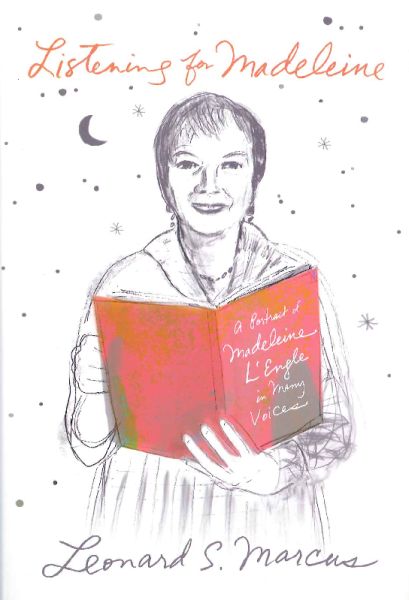
MarcusLeonard S. Marcus, author and literary historian, has compiled Listening for Madeleine (2012), a collection of interviews by friends, family, writers and editors who knew Madeleine L’Engle, author of A Wrinkle in Time, Bright Evening Star, Certain Women and many more titles. Sections concentrating on various aspects of her life include “Madeleine in the Making,” “Writer,” “Matriarch,” “Mentor,” “Friend” and “Icon.”

In his Introduction, Marcus describes a 2002 interview with L’Engle, conducted at her home, Crosswicks.

What followed was an utterly remarkable performance, and an act of generosity that must have drawn on every ounce of her strength and determination. I recognized, from the published interviews I had prepped on, her responses to some of my questions. But much of what she said, I thought, was new. When I asked her about the mail she received from readers, L’Engle told the story of a young reader of A Wrinkle in Time who ended what had seemed a typical fan letter with the news that he was ill with cancer. “We corresponded,” she said, “until he died. It was hard and wonderful both.” Then L’Engle said, “My books are not bad books to die with.” As she uttered this extraordinary remark, a chill ran up my spine. “What do you mean?” I asked her. “What I mean,” she said, “is that when I read a book, if it makes me feel more alive, then it’s a good book to die with. That,” said L’Engle, “is why certain books last.”

The papers of Madeleine L’Engle (SC-03) are archived in the Wheaton College (IL) Special Collections.

A Haunted Memory: Charles Satchel Morris, Jr. and Wheaton College

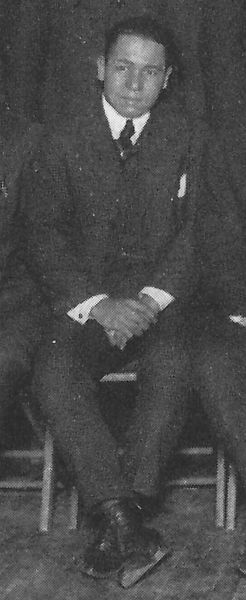
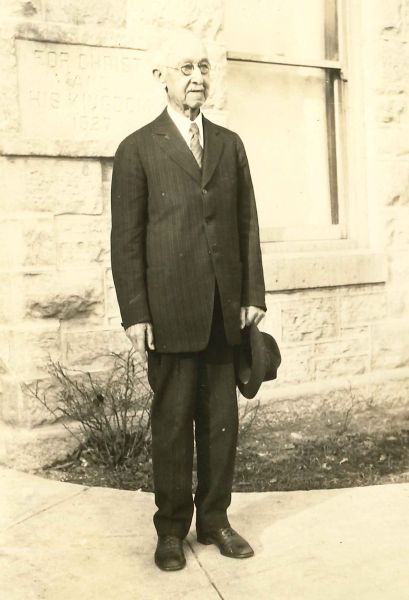
Morris3Charles Satchell Morris, Jr., born in West Newton, Massachusetts, on June 11, 1899, was the great-grandson of ex-slave Frederick Douglass, and the son of a renowned Harlem pastor. Morris, Jr., entered the world equipped with extraordinary talents. Known during his early years as the “boy orator,” he was recognized for his dexterity with the English language. During high school he won the state oratorical contest over 120 white contestants.

As an African American, he frequently faced with poise and fortitude the humiliating challenges of the day. First attending Wilson Academy in New York and then Wheaton Academy, he matriculated to Wheaton College in 1919, studying English, geology, math, history, philosophy and German. In addition, he participated in the Student Army Training Corps (SATC). He was a fine student in all endeavors, but his creativity naturally blossomed in oratory, which he perfected in the busy social milieu provided by the Excelsior literary society.

After Wheaton College Morris attended the University of Chicago and Columbia University, then traveled the country, spellbinding audiences with his splendidly crafted speeches and captivating preaching before securing employment at Tennessee State College as Head of the Department of Speech, then Chair of English at Virginia State College, and eventually as Dean of Baptist Seminary and College, now defunct.

In 1943 he was invited by Dr. Adam Clayton Powell, Sr., father of Representative Adam Clayton Powell, Jr., to deliver the Twentieth Anniversary Sermon of the Abyssinian Baptist Church in Harlem, where Morris’s father had served before Powell, Sr. Dr. Powell writes fondly of Morris, Jr., in his memoir, Against the Tide (1938), honoring his friend for defending him during a controversy:

The brilliant Charles Satchell Morris, Jr., then Dean of Virginia Seminary and College, dropped in at the Baptist Ministers’ Conference at Roanoke, Virginia, where I was being verbally assaulted. He got the floor and by eloquent words expressed his approval of my letter and convinced some of the brethren that my position was in harmony with the teachings of Christ and His Apostles. He told them that they were fighting God and not Dr. Powell.

Eventually Morris moved with his wife to Los Angeles. Desiring to reconnect with classmates in 1946, he requested from registrar Enoch Dyrness a list of local alumni. Dyrness, responding in an interoffice memo, writes:

…Mr. Morris is one of our few colored former students, and was quite a silver tongued orator when he was in school. My last contact with him was at the University of Chicago where he was taking some graduate work. He is quite an aristocratic negro, and I am afraid he has some rather radical leanings. I would be very hesitant about releasing any kind of a list to him, but I thought you might suggest that he get in touch with the president of the Los Angeles club. I hope he has reformed, but my guess is that he is still something of a rascal.

Dyrness does not explain in existing correspondence his perception of Morris as a “radical” or a “rascal.”

Continually in demand as a speaker, Morris preached in 1958 at North Montgomery Baptist Church in Montgomery, Alabama, where Rev. Martin Luther King served as pastor.Morris  Opening remarks for the event were presented by King, who that evening wrote on the program: Tonight we have heard one of the greatest messages we have ever heard. It was inspirational, eloquent, profound and scholarly.
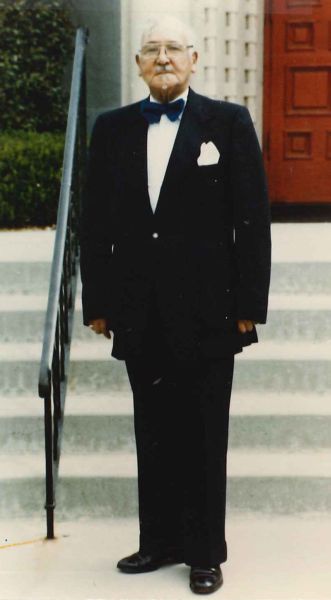
In 1987 Morris received a request from the Wheaton College Alumni Association, asking for a financial contribution to assist with the renovation of Blanchard Hall. On the back of the request he wrote:

While I do not wish to discourage your monetary efforts, my contributions to Wheaton are over as long as I maintain my sanity. I would not give 10 cents to complete Blanchard Hall. This man was responsible for a life-time insult. Please never, never, never ask me to make any further contributions to the College. As a soldier being asked out of the dining room (on the part of a so-called Christian college) which action was sustained by Blanchard, haunts my memory after 69 years. Nor do I wish any more pleas for funds. [The University of] Chicago does not even have to ask, nor does Columbia, both secular schools.

Despite ill feelings toward Wheaton College, Morris admired Edward Coray, director of athletics.  Morris wrote to Lee Pfund, then-director of the Alumni Association: “If they had about 10 persons at Wheaton like Coach Coray, then my attitude toward the College would be entirely different.” The origins of his discontent during his student career can only be surmised; nonetheless, Wheaton College is honored that this distinguished man passed through its doors.

In addition to his roles as lecturer and educator, Morris was the former National Executive Secretary for French war orphans, and a member of the National Security League. Charles Satchell Morris, Jr., died on November 20, 1999, in Santa Ana, CA.
Reflections on a Sabbatical

by Leland Ryken, Clyde S. Kilby Professor of English Emeritus (Spring 2004)

Sabbatical. Noun. A year or half year of absence for study, rest, or travel, given at intervals, originally every seven years, to teachers, in some colleges and universities. This dictionary definition confirms again what I regularly tell my students in my literature courses-that abstraction and propositional discourse, for all their usefulness, never do justice to human experience as actually lived.
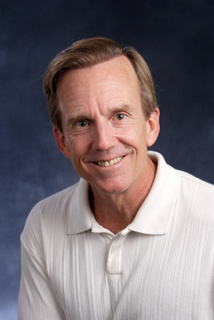
It is doubtless risky for me as a teacher to say that my recently completed sabbatical semester was my best semester in 36 years on Wheaton’s faculty, but…last semester was my best semester at Wheaton.

What my sabbatical semester gave me more than anything else was leisure of a certain type.The word leisure is traceable back to the French word leisir, from the Latin licere, meaning, “to be allowed.” Our word license comes from the same root.

What did I have license to do while on my glorious sabbatical? I was free to pursue a wide range of research and writing projects without intrusions. I was still sometimes the first person to arrive at the office and the last to leave, but since it was something I was free to do rather than obliged to do, even that felt leisurely. In addition, I woke up without the sense of latent anxiety that I feel even after all these years when I wake up knowing that I need to stand before an audience.

My sabbatical gave me the freedom to speak around the country in a way not allowed by my teaching routine-at Milton conferences in Tennessee and Pittsburgh, a Reformation Day in Dayton, a writer’s conference in Virginia, a theology conference in Atlanta, colleges in Alabama, a Christianity-and-the-arts conference in Kansas City.

I also had license to do some of my study and writing in sites far removed from Wheaton, and the result was a feeling of accomplishment with a “value-added” sense of refreshment and expanded horizons. My ongoing scholarly project is to contextualize Milton’s sonnets in a Puritan milieu. It was more invigorating to work on it at a chalet in Wisconsin and a hunting estate in Maryland than in my office.

All of my previous leaves of absence have been conducted under severe time pressure to meet a publishing deadline. I resolutely refused to let it happen this time, and it is one of the best decisions of my scholarly life.

In my writings on work and leisure, I have asserted that leisure must be felt as leisure before it genuinely is such. The sabbatical allowed me to translate that theory into practice, and I am grateful.

The following statement was included at the time of publication:

Dr. Leland Ryken has taught at Wheaton College for 36 years. He has published two dozen books (including edited and co-authored books). In 2003, Dr. Ryken received the distinguished Gutenberg Award for his contributions to education, writing, and the understanding of the Bible. His wife Mary ’88 is a graduate of the Wheaton Graduate School, and his three children- Dr. Philip Ryken ’88, Margaret Beaird ’93, and Nancy Taylor ’98-are graduates of Wheaton College.

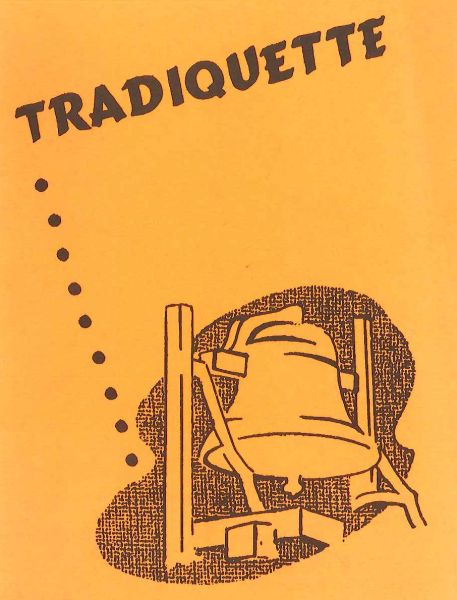
Tradiquette

tradiquette1950 was a very good year for courtesy at Wheaton College. Concerned about campus decorum in daily routines, the Intersociety Council compiled a handy booklet for instructing the average clueless Wheaton student on the correct social behavior involved in such matters as successful interaction with the opposite sex, polite chitchat, appealing dress and proper dinnertime comportment. This instructional is titled “Tradiquette,” smashing together the words “tradition” and “etiquette.” The editors state:

No one wants to feel odd, awkward or ill-at-ease. To be known as a person of poise is very much to be desired. In order that this be true of one, he must know the answers — what the inhabitants of his particular little world considers important — “how to do what, when.” So in your hand you have, for that very purpose, a little guide book compiled by Wheatonites for Wheatonites.

The advice is sensible. For instance, “…be free with the toothbrush. After all, water doesn’t bite, and being friendly with it can take a lot of the sting out of life.” The entry called “Don’t be an iceberg” encourages smiling and friendly conversation with students, staff and campus visitors. The entry called “Don’t be a clinging vine” warns the young lady about excessive arm-in-arm strolling with her guy because “…maybe he doesn’t want the extra load.” She must be reasonable. “But very seldom,” it adds, “does a girl grab a wing without a reason.”

The entry called “Class in class” cautions students against disrespectful behavior like 1) coming in late 2) writings letters 3) looking out the window 4) chewing gum 5) combing hair 6) whispering 7) filing fingernails 8) sleeping. “If you’re guilty of this — to the doghouse, please.”

What would the editors think of cell phones and instant texting?


Standing with the Titans

Billy Graham Center Staff- Lon Allison, Jerry Root, Karen Swanso

by Lon Allison, Former Director of the Billy Graham Center

This summer (2002) I visited with two titans of the Christian faith, John R. Mott and Billy Graham.

Mr. Mott died in the fifties, so obviously, my introduction to him was by way of biographies and his own writings. Mott, more than any other leader, was responsible for the Student Volunteer Movement, which recruited more than 25,000 college students to careers in missions. In 1910, he drew church leaders together at the World Missionary Conference in Edinburgh, Scotland, with the vision to present Christ to every tribe and nation in their generation. Mott was the friend of presidents and the counselor to corporation leaders. His knowledge of world events was so vast and his friends so many that Woodrow Wilson twice sought him to be America’s first ambassador to China. Princeton offered him its presidency, though his formal education concluded with a bachelor’s degree. He declined both appointments because of a more important calling. In 1946 he was awarded the Nobel Peace Prize.Yet for all his accomplishments, he voiced at the end of his life that he wished to be remembered as an evangelist.

This week I sat with Billy Graham for part of an afternoon. Our talks over ice cream sodas covered a range of subjects, but, as was Mott, Mr. Graham is first and forever an evangelist. His love for the gospel and lost people consumes his thoughts. Billy Graham was to the second half of the twentieth century what John R. Mott was to the first; his commitment to the whole church birthed a host of “Edinburghs” around the world. His desire to raise up the next generations of evangelism leaders built the Billy Graham Center.

In our musings, I mentioned my fascination with John Mott and how much he, Billy Graham, reminded me of him. At the mention of Mott his eyes began to sparkle, and he said,”I knew him. He was a giant.” I learned later from one of his closest advisers that Mr. Graham saw John R. Mott as somewhat of a hero and model for his own life.

Yes, I stood with two giants from two generations this summer, though my hunch is neither of them ever thought of themselves as such. They and so many like them are quick to tell us that it is Christ who is to be lauded, and that Christ is the source of whatever accomplishments we may see in their lives.

As I left Mr. Graham and reflected on our talk, I realized that I am the same age difference from our incoming freshmen as Mr. Graham is to me. Who, then, are the “titans” of evangelism in my generation? God save us from ever seeing ourselves as giants of the faith. But should the light of Christ shine through us enough to spill on the generations now rising, let us be both humbled and grateful.

———-

Twenty years ago, the Wheaton Alumni magazine began a series of articles, titled “On My Mind”, in which Wheaton faculty told about their thinking, their research, or their favorite books and people. Former Director of the Billy Graham Center, Dr. Lon Allison (who taught at Wheaton from 2000-2013) was featured in the Autumn 2002 issue.

The following statement was included at the time of publication:

For the past 25 years, Dr. Lon Allison has immersed himself in many aspects of church and parachurch ministry. As an author, educator, minister, evangelist, and performing artist in music and theater, he travels extensively in sacred and secular venues sharing his passion for relating the Christian faith to all aspects of life. In addition to membership on several missions and evangelism boards, Dr. Allison is director of the Billy Graham Center at Wheaton. He lives with his wife, Marie, and three children in Palatine, where he enjoys a variety of athletic pursuits.


Death Takes No Holiday

Men die each day. But in certain instances, an intriguing coincidence occurs. For instance, former U.S. Presidents John Adams and Thomas Jefferson died within four hours of each other — on the 4th of July, no less. On a smaller scale within the Evangelical community, two notables passed on January 1, 1937: Dr. George H. Smith, the “Grand Old Man of Wheaton College Athletics” and Dr. J. Gresham Machen, who staunchly defended theological orthodoxy in the face of encroaching liberalism during the 1920s.

The larger world little noted their passing, but the event was splashed on the front page of the January 6, 1937, student newspaper, The Wheaton Record. Death Takes Drs. Smith, Machen over Holidays announces the headlines in large, bold lettering.

SmithSmith, “…the kindest, friendliest of men,” was Retired Head of the Classics Department. In addition, he was instrumental in founding the Athletics Department at Wheaton College, encouraging intercollegiate sports in an era when it was disparaged by educators. As professor of classical languages and head of the department of foreign languages, he was noted for “untiring zeal.” An ordained Congregational minister, he served churches in California, Hawaii, Ohio and Illinois. Dead at 89, his funeral was conducted at Gary Memorial Church in Wheaton.

J. Gresham Machen, founder of Westminster Theological Seminary, was not associated with Wheaton College, but wrote such classics as What is faith?, The Origin of Paul’s Religion and The Virgin Birth, used during theology classes. Dr. J. Oliver Buswell, President of Wheaton College and fellow Presbyterian, likened Machen to Athanasius, whose witness, if accepted by the church, would have precluded the dark ages. Machen died of pneumonia in Bismark, North Dakota.

Rappings

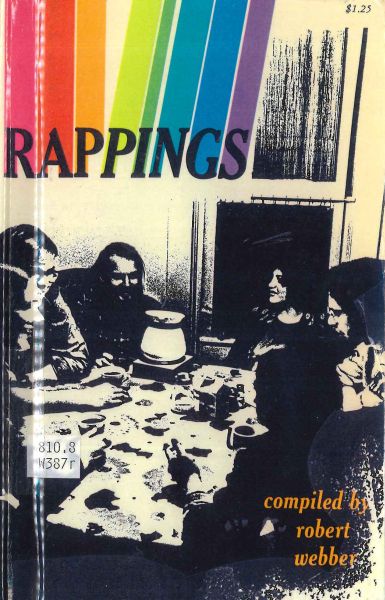
rappingsDr. Robert Webber, former professor of theology at Wheaton College, expressed deep concern for Christian youth entering the 1970s, an era of tremendous political and sociological upheaval. In 1971 he published Rappings, a compilation of poems by Wheaton College students. He writes:

I find that Wheaton College students are far ahead of many of their peers in feeling the problems of modern man. They are awakening out of the isolationism of the previous generation and questing toward a new Christian consciousness, and to this end they are willing to examine their faith to the roots and to purge it of externalism in search of the central dynamic of Christianity.

Their generation is not satisfied with easy answers or with people who avoid hard questions. These young people would join me in saying that hope for mankind is found only in the recovery of the gospel — namely, that in Jesus Christ alienated mankind is forgiven, accepted and called into a new way of life.

The emphasis of the new generation of Christian youth is on the living of the Christian life, not in the sense of adhering to subcultural rules and regulations but in returning to a biblically oriented life, continually deciding to be Christ-followers. The young Christians are intent on taking the teachings of Jesus seriously, feeling that the alternative to a lifestyle centered in things and self is a life like that of Jesus, emphasizing the matters of the Spirit and the enduring values of life.

Rappings does not intend to give a final answer to the world’s problems. It is, rather, a record of young adults honestly expressing their Christian experience as it concerns themselves, their world and their faith.

Writing for Life

by Jeffry C. Davis ’83

I am composing these words at an altitude of 31,000 feet. After attending a four-day conference on teaching writing to undergraduates, I’m flying home. My mind feels like a suitcase packed full of new clothes; many fresh and colorful ideas are returning with me as a result of my participation in various lectures, workshops, and discussions.

Of all the subjects in English that I teach at Wheaton, courses in writing thrill me most. Yet, I must admit that my calling to the composition classroom exhibits a bit of God’s ironic humor: when I was an undergraduate, I loathed writing papers. Breaking a bone or catching a virus seemed like more tolerable experiences at the time. The task of putting words onto a page usually filled me with intense anxiety.

My frustration had little to do with the fact that I lacked a computer with a spell-checker; somehow I managed to type all of my college papers on a manual Smith-Corona, with a well-worn edition of Webster’s dictionary nearby (though I’m certainly grateful for my PC today). Nor did my travail result from a lack of scholastic interest or effort; as a new convert to Christ, I truly believed that the world–in all of its sadness and splendor–should he seriously studied because God made it.

My struggle, I now realize, came from my incomplete understanding of the purpose and practice of writing. As I then perceived it, the main reason I wrote papers was to show my professors two things: first, that I understood the subject matter of their courses, and second, that I understood how to craft my thoughts into grammatical sentences. Consequently, I tended to see writing as a skill primarily concerned with correctness. With each sentence, typically written at a snail’s pace, I asked myself, “Is this right?” And often, a voice inside my head would shout back, “No!” So, I would scratch out the sentence I had just written, and try to write a new one. My preoccupation with correctness paralyzed me.

In her essay, “The Watcher at the Gate,” Gail Godwin explains that most writers have an internal critic, an unrestrained negative voice committed to one goal: “rejecting too soon and discriminating too severely.” In describing her own Watcher, Godwin reveals one of her characteristic messages: “‘What’s the good of writing out a whole page,’ he whispers begrudgingly, ‘if you just have to write it over again later? Get it perfect the first time!'”

Now, as I teach my students how to write, I try to disabuse them of the myth that good writers get it perfect the first time. A great writer becomes great not because of inspiration, but because of dedication and perspiration. For example, I remind them that Thomas Jefferson carefully drafted the Declaration of Independence several times before it was finished, an accomplishment which he was prouder of than being the third President of the United States. Jefferson didn’t get his writing perfect the first time.

Instead of primarily focusing on the product of writing, I encourage students to consider the process of writing. Serious writers, more often than not, develop good habits that naturally foster good writing. They learn to observe, and to wait, and to receive; this approach requires a certain degree of humility.

Serious writers learn how to write when they don’t feel like writing, becoming obedient to the task at hand. They care about words as they think in ink. The novelist E.M. Forster explains, “How do I know what I think until I see what I say?” And after they have written something, they let other—those whom they trust—examine their work, and they actually welcome constructive criticism.

What’s more, they learn how to revise, which literally means to see again with new eyes; they accept the necessity of change.

In a real sense, the process of writing is analogous to the process of spiritual growth. Working with words demands discipline, which paradoxically sets us free to write well. So, too, living for the Word requires us to let go of our inclination to strive for our own perfection, which inevitably brings paralysis. We are asked, instead, to develop a habit of the heart, wherein we welcome the Word to dwell more fully in us. “In the beginning was the Word, and the Word was with God, and the Word was God In Him was life, and that life was the light of men.”

———-

Twenty years ago, the Wheaton Alumni magazine began a series of articles, titled “On My Mind”, in which Wheaton faculty told about their thinking, their research, or their favorite books and people. Current Associate Professor of English, Jeffry Davis (on faculty since 1990) was featured in the Spring 1997 issue.

The following statement was included at the time of publication:

Dr. Jeffry C. Davis ’83 (Assistant Professor of English and Director of the Writing Center) has taught writing at Wheaton for more than a decade. He earned his M.A. in English from Northern Illinois University. Presently he is working to complete his Ph.D. at the University of Illinois at Chicago. His dissertation focuses on Quintilian, a first-century teacher of writing. In his spare time he gardens and listens to country music.

The Cross of Gold and the Trumpet of Distraction

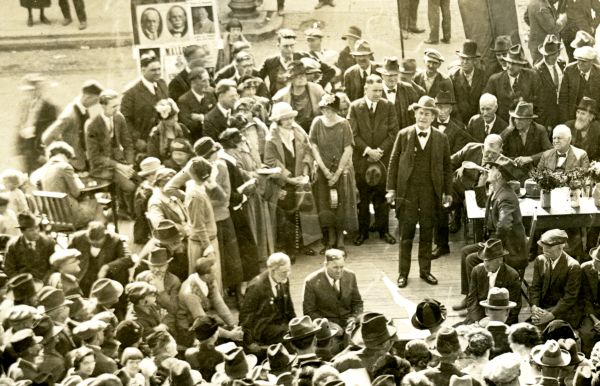
It isn’t often that a professor of history is allowed to participate in history, if only fleetingly, but Dr. S. Richey Kamm, Professor of History, Political Science and Social Science at Wheaton College, sat very close to William Jennings Bryan, three-time Democratic candidate for President of the United States and one of most flamboyant and influential figures of the day.

Bryan, “The Great Commoner,” championed causes like prohibition and women’s suffrage. In 1921 he visited Wheaton College, lecturing forcefully to faculty and students against the theory of evolution, later using those very arguments in his seminal debate with attorney Clarence Darrow during the 1925 Scopes Monkey Trial. Ironically, theistic evolution eventually won the day at Wheaton College. Bryan was famous for his “Cross of Gold” speech, which responded to those demanding a currency based upon a gold standard. He shouted, “We will answer their demand for a gold standard by saying to them: You shall not press down upon the brow of labor this crown of thorns, you shall not crucify mankind upon a cross of gold.”

In 1924 young Kamm heard Bryan speak in Greenville, Illinois. He writes on the back of the photo:

You will find me seated on the table at the left of the picture. This shows only a part of the crowd. It stretched out for a long way on each side. They had quite a time with the old fellow with the ear trumpet. He got up on the platform and got his trumpet so close to Bryan’s mouth that Bryan had to stop and get the old fellow a chair.

A Third Testament, available on DVD

Malcolm Muggeridge (SC-04), British journalist, responded with keen sensitivity to pious thought couched in beautiful language, especially as he embraced the Christian faith in his later years. In 1974 he hosted a documentary series highlighting the spiritual contributions of six world-class authors: St. Augustine, Blaise Pascal, William Blake, Soren Kierkegaard, Leo Tolstoy and Dietrich Bonhoeffer.

Describing their work as a “third testament” (after the Old and New Testaments) testifying to the reality of God and the resurrected Christ, Muggeridge visited their countries, homes and haunts, attempting to capture something of the environment in which they flourished. Two years later he adapted the series into a book, each chapter profiling one of the featured authors.

Unavailable for many years, A Third Testament, a two-disc DVD containing six 55-minute episodes, is now available from Ignatius Press, http://www.ignatius.com or 1-800-651-1531.