Mission Opinion

Guest posting by Special Collections staff member

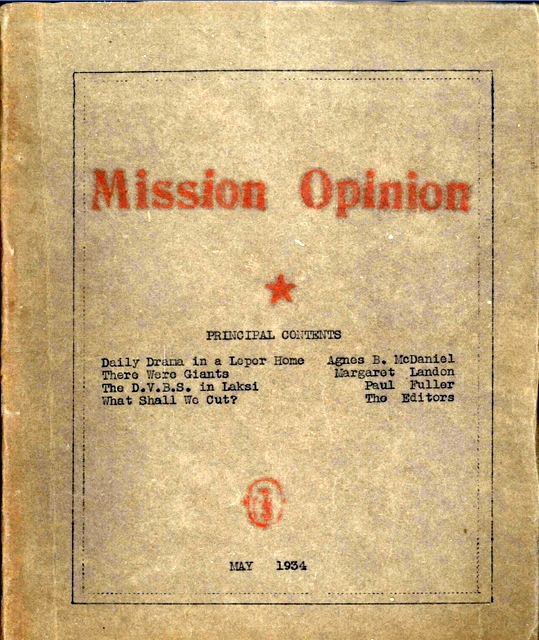
Mission Opinion was a controversial publication edited and published by Kenneth and Margaret Landon in 1934 and 1935, from their missionary post at Trang, Siam. It was a strictly in-house magazine for the missionaries of the Presbyterian Mission, with which the Landons served at the time. Its aim was to facilitate “expressions of opinion by members of the Siam Mission on matters relating to the policies and practices of the Mission.”

The impetus for the magazine was a perceived lack of adequate communication among members of the Mission. The Landons took initiative in starting the publication and financed the printing of Mission Opinion out of their personal funds. They duplicated it in Trang on a mimeograph machine Kenneth had procured from Bangkok. From the outset it was understood that they would publish for “a trial period of twelve months.” A total of 10 issues were produced over the year running from May 1934 to April 1935, ranging in length from 30 to 60 pages.

The Mission leadership may not have been ready for the open exchange of views made possible by such a publication. They are not likely to have welcomed even honest questioning of their policies and discussions concerning the overall direction of the Mission. Mission Opinion included frank discussion of what should be cut from the budget given the decline in the Mission’s financial and human resources in the midst of the Great Depression. The term ‘mission station’ is a throwback to a bygone era whose approach appears to twenty-first century eyes hopelessly entangled with colonialism; yet, a major challenge faced by the Presbyterian Mission in the Landons’ time concerned precisely whether to continue staffing their existing stations, whether to close some, or whether additional ones ought to be established.

Margaret said, “Let’s put out a little magazine of our own.”

Another burning question, to which the bulk of two issues was devoted, was ‘intensive’ vs. ‘extensive’ evangelism. Could they simply nurture those who had made some kind of profession, relying on biological growth as the faith was transmitted from parent to child? Or was it rather necessary to deliberately and incessantly push beyond the boundaries of the fledgling Thai church to the ninety-nine percent of the population who remained outside? Rev. Paul Eakin, the Mission’s executive director, gives his opinion concerning the evangelism controversy in the January/February 1935 issue. He believed that shoring up earlier gains ought to take priority over concerted proclamation in broad swaths of the country which remained virtually untouched by the gospel. History, however, seems to have vindicated the Landons and others who favored a more aggressive outward thrust.

———-

The Margaret and Kenneth P. Landon Papers are housed in the Wheaton College Archives & Special Collections and are available for research.

In His Time

Twenty years ago, the Wheaton Alumni magazine began a series of articles, titled “On My Mind”, in which Wheaton faculty told about their thinking, their research, or their favorite books and people. Professor Emeritus of Bible and Theology Walter Elwell (who worked at Wheaton from 1975-2003) was featured in the Winter 2003 issue.
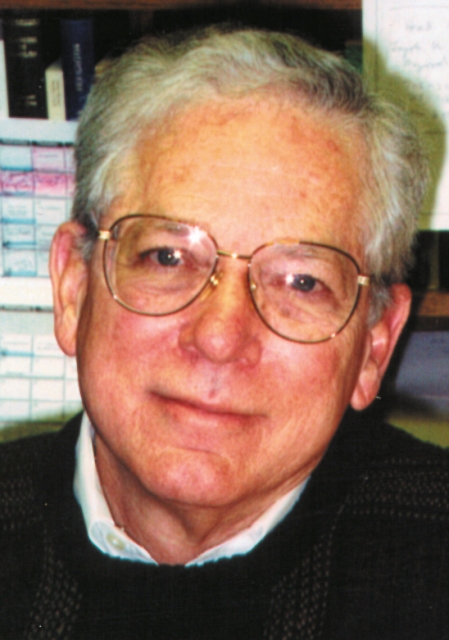
As an undergraduate student at Wheaton more than 40 years ago, I felt something of a call to the mission field—first as a medical missionary and then as a Wycliffe translator. Neither of these materialized, and instead I pursued an academic career in New Testament studies.

I was never sure why the Lord led me in another direction rather than to the mission field, where I felt the need was so great and the laborers so few. I prayed about that over the years, but nothing seemed to take any particular shape in my mind.

Then, in 1989 to 1991, the Soviet Union fell and that part of the world opened up to missionary work from the West. By that time, urgent stirrings had arisen in my heart, and in a wonderful moment it all became clear—Eastern Europe was in desperate need of guidance and help at the academic level to train people for the next generation of leadership. More than two generations had been lost and there was no time to lose; cults and charlatans were trying to take advantage of the surging spiritual hunger in that part of the world.

God then answered my prayer of 40 years earlier, directing me to a ministry of training young Europeans academically for leadership in the church and the preaching of the Gospel.

Almost immediately after the fall of Communism, the Graduate School inaugurated a program of on-and off-campus training for these East Europeans. Other Wheaton professors and I made numerous trips to all parts of the former Soviet Union to teach in seminaries, help establish M.A. and Ph.D. programs, visit refugee camps, and sometimes (literally) walk through mine fields to reach the schools and churches where we were speaking.

Since these East Europeans also needed relief from their often oppressive situations, the Graduate School also established a six-week tutorial for scholars and educators from the former satellite nations. We bring anywhere from 15 to 25 participants (free of cost to them) for intensive personalized training in an area of study they have selected. While here, they are assigned a faculty mentor, make field trips to view local ministries, attend seminars, hear a series of speakers, and also work in their chosen area of interest.

In the last eight years, more than 90 scholars from 13 different countries have participated in the program. As a result, over 15 books have been written, eight Ph.D. degrees have been earned, and numerous other goals have been accomplished—from establishing children’s ministries to running a school. All this has been a great blessing to us, and we solicit your prayers on our behalf.

How could anyone have guessed at the height of the Cold War that someday the Iron Curtain would be removed and teacher/administrators would be needed to rebuild what had been torn down, seemingly for all time? But God knew. And in His time, he directed me, and others, to prepare for it.

What a blessing to follow the Lord, even when the way is unclear. For as William Cowper said, “He will make it plain.” It is testimony to the grace of God and the mystery of His ways that this door has opened and Wheaton has been enabled to step into the gap.

———-

Walter A. Elwell, born 1937 in Florida, is an evangelical theologian and noted editor of several evangelical standard reference works. He is professor emeritus of Bible and Theology at Wheaton College where he taught from 1975 to 2003. Elwell earned his B.A. ’59 and M.A. ’61 from Wheaton College. He then attended the University of Chicago and University of Tubingen before earning his Ph.D. from the University of Edinburgh. He has been a consultant to both the Evangelical Christian Publishers Association and the Evangelical Book Club, and a member of the Society of Biblical Literature, Institute for Biblical Research, Evangelical Theological Society, and Chicago Society of Biblical Research.
Studs and Clyde

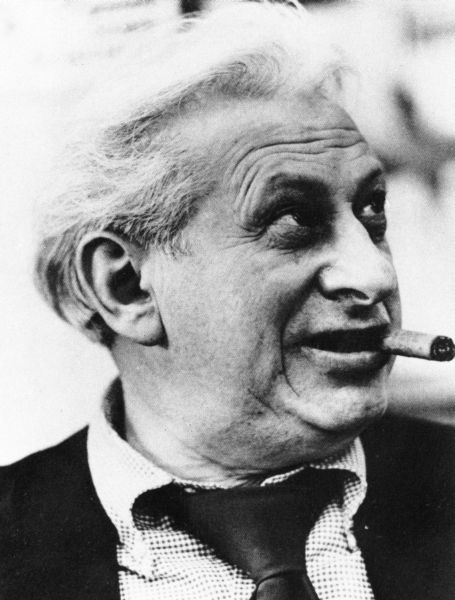
Chicago’s distinctive personality is a complex amalgamation of revolutionary architecture, excellent food, famous streets and most importantly, its multitudinous colorful citizens, wise-cracking and hardworking. For decades the man who most perfectly captured the spirit of the Windy City, serving as its most loyal ambassador, was Louis “Studs” Terkel. A graduate of the University of Chicago and the Chicago Law School, he acted on stage and radio and wrote scripts for WGN, among many other jobs. Forever curious, he hosted his own radio show on WFMT, enthusiastically interviewing scores of fascinating writers, actors and politicians, signing off with his signature, “Take it easy, but take it.” He acquired his nickname from James T. Farrell’s trilogy, Studs Lonigan, about a Southside Irish family struggling during the Depression.

Terkel was probably best known for conducting oral interviews, collected as transcripts in a series of books. Division Street: America (1966) explores urban conflicts of the 1960s. The Good War: An Oral History of World War II won the 1985 Pulitzer Prize for nonfiction. His autobiographical writings are contained in three volumes, Talking to Myself: A Memoir of My Times, (1977), Touch and Go (2007), and P.S.: Further Thoughts From a Lifetime of Listening (2008).

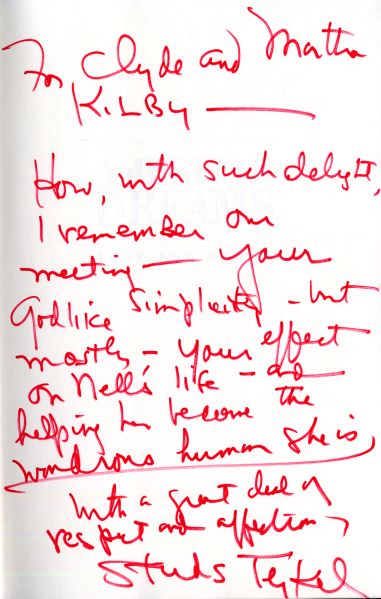
Visible in Chicago and nationally, Terkel was widely connected with many prominent figures, so it is not surprising that he knew Dr. Clyde Kilby, professor of English at Wheaton College and founder of the Marion E. Wade Center, housing the manuscripts of C.S. Lewis, J.R.R. Tolkien and five additional British writers. What is somewhat surprising is an inscription Terkel wrote for Kilby and his wife, Martha, in the front flyleaf of American Dreams: Lost & Found (1980):

For Clyde and Martha Kilby — How, with such delight, I remember our meeting — your godlike simplicity — but mostly your effect on Nell’s life — and helping her become the wondrous human she is. With a great deal of respect and affection, Studs Terkel.

According to Terkel’s close friend, film critic Roger Ebert, the indefatigable journalist was “a contented, not an outspoken, atheist.” Considering that, it is intriguing that Terkel recognizes and commends the Kilbys for their “godlike simplicity.” Though the full story behind the inscription is unknown to the Archives, it is fully appropriate that two men who collected stories and relished good storytelling intersected with such intensity, however briefly.

Studs Terkel died at 96 in 2008.

Unwitting Accomplices

Twenty years ago, the Wheaton Alumni magazine began a series of articles, titled “On My Mind”, in which Wheaton faculty told about their thinking, their research, or their favorite books and people. Franklin S. Dyrness Professor Emeritus of Biblical Studies C. Hassell Bullock (who worked at Wheaton from 1973-2009) was featured in the Spring 2001 issue.

I have sometimes pondered the question, “Is it possible for a society to commit the sin against the Holy Spirit?” Obviously, Jesus, in Matthew 12, spoke about individuals who had turned the moral code upside down–good was evil, and evil was good. Isaiah too described that state of moral depravity:”Woe to those who call evil good and good evil” (Isa. 5:20).This is what the sin against the Holy Spirit means. John Milton summed it up well in Satan’s apostrophe,”Evil be thou my Good.”

Yet I don’t think believers can commit this sin.They belong to God, and Jesus assured us, “I give them eternal life, and they shall never perish, and no one shall snatch them out of my hand” (John 10:28).Then why should believers be concerned about this warning at all? Perhaps the answer is that we can become accomplices in the process of moral decline.We can, by our own indifference to the issue of right and wrong, abet our society in its trek toward moral inversion. In the debate over our current attorney general’s confirmation, one opposing senator referred to abortion and homosexual rights and called them “fundamental values.” “Rights” have become “values.”The moral battle is being waged in the church too. Despite the mounds of exegesis that favor moral clarity, the claim is that we should be neutral on certain moral issues. If Satan can first get us to become neutral or indifferent on morality, then he has made us accomplices in progress toward the reversal of moral standards.

Jesus warned the religious leaders of His day that, if they continued to see the work of God and persisted on calling it evil, their hearts would fossilize in that state of thinking.They would see evil and think it good, and good, and think it evil.Their moral code would turn upside down, and they would become incapable of repentance and thus of forgiveness.

The final goal of our moral journey is not neutrality about right and wrong. Even when we insist that one has the right to determine one’s own moral standards, we become a catalyst in the movement toward moral inversion.Then there are no standards of the whole, no absolutes by which our actions and attitudes can be reckoned right or wrong. Everyone has become a law to oneself.This is happening with homosexuality, and there are signs that some are determined to put pedophilia in the same category.

As Christians, in our attitude toward sin we are either accomplices or members of the opposition.There is no neutrality. Some of us need not only to repent of the sins we have committed, but we need to repent of our neutrality to sin.We need God to renew in us a sense of righteous indignation as well as compassion about the sinful world we live in. C. S. Lewis said that an absence of righteous indignation might be one of the alarming symptoms of a society that is losing its moral moorings. Can a society commit the sin against the Holy Spirit? Broadly speaking, I believe it can.That’s what happened to Canaanite society whose sexual perversion rendered it irredeemable. God help us not to be an accomplice in the progress of our cultural journey toward moral inversion, where good is evil and evil is good.

Why They Left

Guest posting by Special Collections staff member

Kenneth Landon graduated from Wheaton in 1924, just ahead of his wife-to-be Margaret (Class of ’25). Newly married and full of hope, they set out in 1927 for a lifetime of ministry in Southeast Asia with the Presbyterian Mission. For most of their decade of service in Siam, they were stationed at Trang, 500 miles south of Bangkok.

The Landons had considered their call into mission to be life-long. How then did it come about that just ten years into their work in Thailand, they came home on furlough never to return as missionaries? As you might imagine, multiple and complex issues were involved. The fact that their resignation letter, dated October 9, 1940, runs twenty one typed, double-spaced pages attests to that.

The letter, written after three years away from Thailand and a year after they formally severed ties with the Mission, details their reasons for leaving. There had been serious conflict between the Landons and the leadership of the Presbyterian Mission in Thailand. Yet the Landons alleged that the problems pre-dated their arrival in Thailand. On page two of the letter, we read: “The inharmoniousness of the Mission was clearly evident when we joined it in 1927.”

The lightning rod for their criticisms was the Mission’s Executive Secretary, the Rev. Paul Eakin. Writing in 1940, the Landons decried the fact that “strifes, jealousies, and antagonisms are worse now than they were thirteen years ago.” The Landons’ enumeration of Eakin’s alleged misdeeds runs the entire length of the letter. Chief among their concerns were a “policy of secrecy”–poor communication within the Mission, together with personal animosity and slander on the part of Eakin toward themselves.

But there were wider issues as well. The Landons did not agree with the overall emphasis of the Mission at that time. It was a period of growing institutionalism; evangelistic efforts were being curtailed in favor of educational and medical work. The Landons charge in the letter that “Mr. Eakin has openly opposed the work of evangelistic missionaries like…ourselves.”

Kenneth, looking back at the situation decades later, asserted (in The Landon Chronicles) that the Mission had been “absolutely backward and without vision,” and that the Mission people were “not raising up a national church, as they should, and were failing to do the obvious things to create an indigenous, Thai church.” It is interesting to compare the substance of the carefully-worded 1940 letter with Kenneth’s less-guarded comments forty years later. In the latter account there is no mention of Eakin; he speaks only against “the Mission.” Perhaps time had faded or healed the memories and it was no longer personal; the passage of forty years certainly had given him a broader perspective.

The Landon family in 1937, just before they left Thailand

The Landons’ exit from Siam in 1937 is a case study in missionary attrition. The cause of Christ in Thailand lost two sharp and passionate minds–at least as far as their presence on the ground as missionaries. No doubt they continued to engage in the spiritual battle, helping the fledgling Thai church through their prayers in the ensuing decades. They also maintained a number of relationships with Thai friends–Christians and non-Christians alike. Both Kenneth and Margaret distinguished themselves in other pursuits following their resignation from the Presbyterian Mission. Kenneth worked for the government as a specialist in Southeast Asian affairs. Margaret became a notable author, best known for her work Anna and the King of Siam, upon which the Broadway hit The King and I is based. Yet, what might their talents and drive have contributed to the mission to reach the Thai people in the 1940’s and beyond?

The Landons’ resignation letter is part of a larger body of material that had been restricted until 2010.

———-

The Margaret and Kenneth P. Landon Papers are housed in the Wheaton College Archives & Special Collections and are available for research.

Three Cheers for Prexy

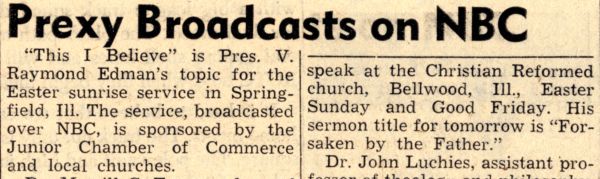
Since its origin in 1855-60, the word “prexy,” representing a shortened term for “president,” was invoked for decades by students on American college campuses as a term of endearment for their administrative leader. At Wheaton College the term was applied to presidents Charles Blanchard, J. Oliver Buswell and, most familiarly, V. Raymond Edman. While visiting campus for reunions, generations of older Wheaton College alumni happily swap stories, often casually referring to the piety and dedication of their beloved prexy, not needing to explain his identity. Interestingly, “prexy” is not applied to subsequent presidents Hudson Armerding, Richard Chase, Duane Litfin or Philip Ryken, perhaps because it has simply fallen out of style.

Wheaton College and the Encyclopedia Britannica

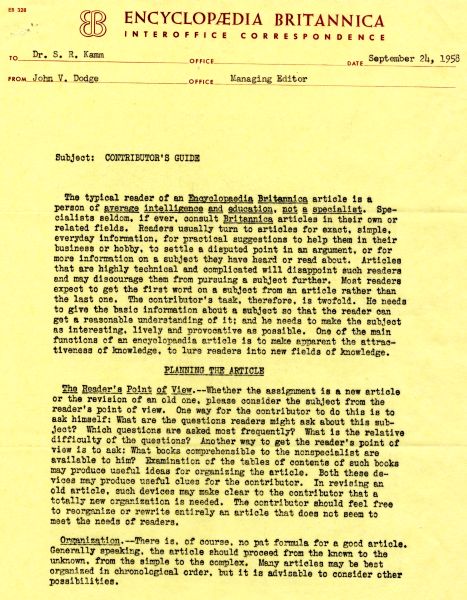
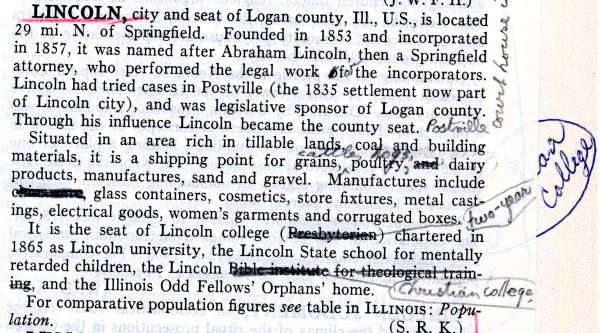
For over 200 years, from 1768 to the present, the Encyclopedia Britannica has published “the sum of knowledge,” collecting articles on a vast array of subjects written by experts. For decades the multi-volume set has graced the shelves of homes, schools and libraries the world over. In 2012 the company announced that the 2010 edition would be the final printed set. From now on Encyclopedia Britannica will be published exclusively online. Throughout the decades Britannica has engaged the talents of many capable contributors to write entries. One such was Dr. S. Richey Kamm, professor of history and political science at Wheaton College. In 1958 Kamm was asked by John V. Dodge, Managing Editor of the Encyclopedia Britannica, to revise an article about Lincoln, Illinois. Dodge instructed Kamm to not exceed 150 words and emphasize Abraham Lincoln’s role concerning the the city. The article was to completely replace the previous version, “to be written from a fresh point of view.” Dodge included a four-page, single-spaced Contributor’s Guide. “The typical reader of an Encyclopedia Britannica article is a person of average intelligence and education,” states the Guide, “not a specialist. Specialists seldom, if ever, consult Britannica articles in their own or related fields.” The Guide covers such matters as organization, length, quotations, copyright, bibliography, illustrations, captions and photographs. “There is, of course, no pat formula for a good article,” the Guide goes on. “Generally speaking, the article should proceed from the known to the unknown, from the simple to the complex. Many articles may be best organized in chronological order, but it is advisable to consider other possibilities.” Kamm continued revising this entry for several more editions.

Kamm’s handwritten corrections for the 1967 entry about Lincoln, Illinois

The Corruption of Conscience

In honor of the recent homegoing of Chuck Colson, an abridged version of his address “The Corruption of Conscience” (given during the Wheaton College Graduate School commencement ceremonies on May 6, 2000) is featured below. Charles W. Colson is the author of over 15 books that have sold over 5 million copies, and his daily radio commentary, “Breakpoint,” reaches an audience of over 3 million people. Mr. Colson first achieved national notoriety as an aide to President Richard M. Nixon from 1969 to 1973, when he as known as the White House “hatchet man.” After converting to Christianity and serving seven months in prison on Watergate-related charges, he founded Prison Fellowship Ministries, now the largest prison outreach organization in the world.

More than ever before in American history, indeed in Western history, we are witnessing the near-death of conscience. By virtue of being created in His image and likeness, all men have a conscience that is sensitive to God’s Law. Paul writes:”For when the Gentiles who do not have the Law do instinctively the things of the Law, these, not having the Law, are a law to themselves, in that they show the work of the Law written in their hearts, their conscience bearing witness, and their thoughts alternately accusing or else defending them” (Rom. 2:14-15, NASB). But for many years this God-given internal moral compass has been rapidly faltering. I regularly confront that brutal truth in prisons across the country. An incident in Indiana a few years ago brought it home to me dramatically. I had visited the prison several times before, but that day a young inmate responded to my proffered handshake by smacking my hand away–a first for me. In many years of visiting prisons, I had never before encountered such direct and immediate hostility from a complete stranger. For obvious reasons, prisoners are rarely cheerful, but I saw in those eyes that day a chilling hardness I had never encountered before. Since then, however, I have seen similar hardness reflected in the eyes of countless other inmates, particularly younger ones.

Click HERE for the full address.

Charles W. “Chuck” Colson (1931-2012)

In the early 1970s during the days of Watergate and the waning years of Richard Nixon’s administration, Charles “Chuck” Wendell Colson was Special Counsel to the President and notoriously feared as the White House “hatchet man.” He was brazenly labeled as “incapable of humanitarian thought” according to the media of his day and freely admits playing political dirty tricks on behalf the President and the Republican Party. After word of Chuck Colson’s dramatic conversion to Christianity, the Boston Globe reported “if Mr. Colson can repent of his sins, there just has to be hope for everybody.” Nonetheless, justice prevailed and he was the first member of the Nixon administration to be incarcerated for Watergate-related charges in 1974. As a convicted felon Colson was sentenced to a one to three-year sentence, fined $5,000 for obstruction of justice, disbarred in the District of Columbia and prohibited from using his licenses from Virginia and Massachusetts. Colson eventually served seven months in Maxwell Correctional Facility in Alabama and was released in January 1975. Later that year his memoirs Born Again were published. On April 28, 1976 Colson was invited to address Wheaton College in Edman Chapel where he shared his testimony and urged evangelical students to engage the political process.

Listen to the unedited audio of Colson’s Wheaton College Address (excerpted below)

It’s no time for despair…We live in America, in the most priceless freedom that man has ever known, because this country was begun by disciples of Christ. The pilgrims that came here cam to have the freedom that Jesus Christ offers every single human being, the most radical, revolutionary experiment in the history of mankind, the radical idea that “No…God doesn’t rule through a divinely ordained king, but God rules, His sovereign rule is in the ilfe of every single human being, that every single human being draws his power from God, that the individual is supreme in the eyes of the sovereign God, and that government is created to provide the needs of the aggregate collection of God endowed individuals, endowed with the power of God.” And look back upon the history of the Great Awakening in 1740, the cradle of the American Revolution. What was it? It was a spiritual revial that George Whitfield led, riding up and down the colonies from Savanna to New Hampshire and back south again, preaching a rebirth in Jesus Christ, that every American might know the human freedom of having Christ in his life…

What a priceless freedom we have, and it isn’t going to be saved for us by any human being. We can’t cop out, we can’t expect Washington to do it, we can’t expect the government to suddenly have the power of God; that was the very thing our forefathers rejected. We can’t expect one of our number of born-again believers to lead this nation on his back unless the hearts of the American people are turned to God…God’s secret plan for the nations is Christ in you, and it begins here today, this day. May the Love of the Lord Jesus be with you.

Twenty-five years later, Chuck Colson returned to Wheaton College and gave both the undergraduate and graduate Commencement addresses to the Class of 2000.

He continued to work tirelessly with Prison Fellowship, a non-profit organization devoted to prison ministry he founded in 1976. Colson was a public speaker, author, radio commentator, and founder of the Wilberforce Forum (now the Chuck Colson Center) as the teaching and advocacy arm of Prison Fellowship. Colson has received 15 honorary doctorates and in 1993 was awarded the Templeton Prize, donating the $1 million award to further the work of Prison Fellowship. In 2008, Colson was honored by President Bush with the Presidential Citizens Medal for his years of work with prisoners and their families. Chuck Colson died on April 21, 2012 at the age of 80.

The Papers of Charles Wendell Colson are located at the Billy Graham Center Archives on the campus of Wheaton College, Illinois. Additional materials pertaining to Colson and the Watergate hearings are contained in the Wesley G. Pippert Papers at the Wheaton College Archives & Special Collections.

The Other Wheaton College

Delivering the 2010 commencement address at Wheaton College, NBC Today Show anchor Ann Curry famously flubbed when she cited several distinguished alumni: evangelist Billy Graham, filmmaker Wes Craven and Speaker of the House Dennis Hastert. The problem, as she quickly learned, is that these notables graduated from the Wheaton College in Illinois, not the one located in Norton, Massachusetts, where Curry had been invited to speak. “I am mortified by my mistake,” she wrote, “and can only hope the purity of my motive, to find a way to connect with the graduates and encourage them to a life of service, will allow you to forgive me.”

Curry’s eloquent apology was accepted. In fact, her mistake is common. Both colleges frequently field inquiries meant for the other. Though both institutions were founded by families named “Wheaton” rooted in the East, there is no known connection between their bloodlines.

Wheaton Female Seminary, c. 1840

Founded in 1834, Wheaton Female Seminary was designed to accommodate young women of the middle classes seeking the same education as that provided by colleges for men. Wheaton was chartered as a four-year liberal arts college in 1932, and became co-educational in 1988.

Notable alumnae from Wheaton College of Norton, Massachusetts, includes 60 Minutes correspondent Lesley Stahl, former EPA Director Christie Todd Whitman and Oscar-nominated actress Catherine Keener.