“The union of all who love in the service of all who suffer”

Chicago has always been seen as a rough-and-tumble kind of place stuck in the center of this country’s vast agricultural region and far short of the glories of the refined cities of either coast. The former stockyards of Chicago reinforced this. It is said that Chicago’s name can be traced back to native peoples and their name for the wild onions found locally. Onions are grown and mired in mud and muck and this is not too far from an apt description of Chicago’s history.

In the dozen or so years around the turn of the twentieth-century several individuals and writers sought to chronicle and clean up the filth of Chicago. The key event that afforded the opportunity for much of the work was the World’s Columbian Exposition in 1893. Having worked in Chicago for several decades during his worldwide evangelistic ministry, Dwight Lyman Moody held evangelistic meetings for six months during the “fair.” His campaigns have been detailed in Moody in Chicago (1894).

Whereas Moody was the evangelist, William T. Stead was the journalist. His chronicling of the religious needs of Chicago were quite different. Though Moody garnered the public’s attention it was never through outlandish acts or prurience. The same cannot be said for Stead’s provocative work If Christ Came to Chicago. Stead had come to Chicago from London as the fair was closing up. He was known as a great reporter and social reformer and had come to Chicago to study its newspapers, but the exposition’s great White City caught his attention. The thought of its destruction seemed too much and Stead sought to preserve the glories created there. As Stead remained in Chicago his eyes caught sight of another Chicago. Rather than the gleaming purity of the White City he saw the filthy darkness of the Black City that was in need of social and civic regeneration. In all his travels he had never encountered a city with greater promise, or problems.

Map - If Christ Came to ChicagoThe closing of the fair had left many out of work and the economy of Chicago, previously propped up by the fair, tumbled into an economic depression. The great needs that emerged also facilitated an environment filled with licentiousness and debauchery. Stead wrote If Christ Came to Chicago to document the specifics of this environment and mapped it out with great specificity in Chicago’s First Ward. This laid the groundwork for future ethnographic studies of Chicago, most notably the work conducted by Hull House.

By writing this book Stead hoped to enlist the help of Chicago’s churches, the labor unions, and millionaires, many of whom, he felt, had neglected their Christian duty to the poor. His jeremiad was written to incite action. It certainly incited a public response, especially the book’s map of the location of bordellos, saloons, and pawn brokers.

The Octopus on the LakeDespite Stead’s goal of bringing together a “union of all who love in the service of all who suffer,” the dirt wasn’t easily shaken from the wild onion. The roots of the onion are many. Nearly a decade and a half after the close of the Columbian Exposition it was still quite easy to document the problems of Chicago. The Social Evil in Chicago (1911) was a study conducted by the city’s Vice Commission and served as it’s report to the Mayor and city Council “of exciting conditions” in Chicago. The conditions of Chicago had not improved and in some ways were normalized and facilitated as can be seen by the official licensing of prostitution within the bounds of Wentworth and Wabash avenues (p. 38).

Chicago can still be described in many of the same ways as these texts from a century ago. The corruption of Chicago’s First Ward has been the fodder of newspaper accounts in recent decades. It still could use a “union of all who love in the service of all who suffer.”
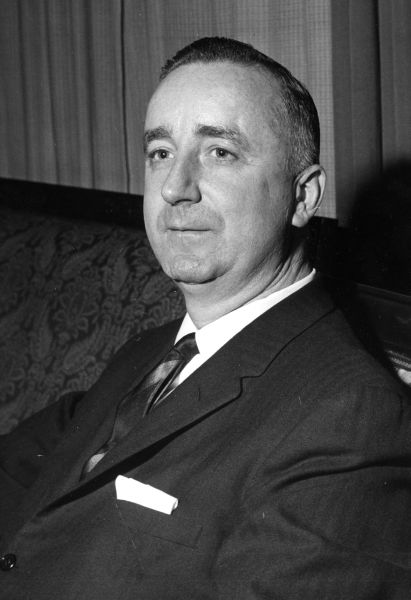
Edgar C. Bundy

Edgar C. Bundy was a strident opponent of left-wing politics and one of the supremely colorful personalities inhabiting Wheaton. A retired Air Force former Staff Intelligence Officer, serving in every major theater of operations during World War II, he was also the Chief of Research and Analysis, Headquarters Intelligence, of the Alaskan Air Command after the war. He testified frequently as an expert witness in both open and executive sessions of both houses of Congress and state legislatures. An ordained Southern Baptist minister, Bundy preached at conferences and churches across America. Opposing the incursion of theological compromise and radical leftism, he spoke on hundreds of radio and television talk shows, debating such figures as Bishop James A. Pike and spokesmen of the Communist Party. He was a member of the Mayflower Society, The Order of Founders and Patriots of America, the Sons of the American Revolution, the American Legion, The Military Order of the World Wars, the Veterans of Foreign Wars and was past president of the Miami Beach Symphony Orchestra.

For decades he and his wife, Lela May, resided in the Jesse Wheaton home, built in 1838, given to them by a Wheaton family member as an inheritance. At their home the Bundys entertained doctors, attorneys and politicians. They had no children, but Lela May worked alongside her husband in his endeavors, including raising German shepherds which they often brought into their offices at the right-wing Church League of America. As president of the organization, Major Bundy (as he preferred) maintained a far-reaching mailing list for the distribution of his newsletter and books. His roommate in officers training school was Senator Lloyd Bentsen, and during drill exercises he marched with actor Clark Gable. Bundy’s collection of books, maps and file cards was occasionally used by the FBI for research. World-traveled and widely connected, he enjoyed friendships with powerful conservative voices like Robert Taft, William F. Buckley and Ronald Reagan. Bundy, single-minded, fearless and irascible, was a Cold War warrior who undoubtedly loved his country and did not deviate from his principles. Bundy perceived that certain evangelical leaders and institutions had been co-opted by unfriendly forces through the slow, steady poison of compromise. In books such as How Liberals and Radicals are Manipulating Evangelicals and How the Communists Use Religion he presents his expose of their tactics, chronicling the evangelical drift toward liberalism and Communism. “Great moral damage has been done to the United States as a result of this neoevangelical compromise,” he writes.

Pearl S. Buck

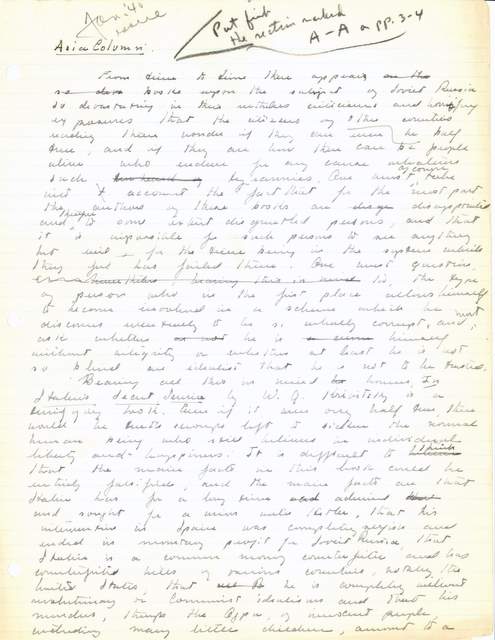
In recent days a collection of four Pearl Buck manuscripts have been placed on deposit at the Wheaton College Special Collections. These include a hand-written “Son of Fate” manuscript, “Cultural Contacts of the West with the Far East”, a typed speech given to the Cooper Union on February 1, 1944, and a signed autograph manuscript of her “Asia Column” from 1940. The featured “Asia Column” is five pages on 8.5 x 11″ three-ring paper with heading in Buck’s hand, and includes Buck’s signature, with cross-outs and rewrites by the author. In April of 1935, Buck took charge of the “Asia Book-Shelf” column for Asia Magazine, assigning books for review and writing many of the notices herself. In this five-page manuscript she choose four books for review that were incredibly significant and have been reprinted and still available since first published in 1939: In Stalin’s Secret Service (Krivitsky), British Diplomacy in China, 1880-1885 (Kiernan), A Japanese Village (Embree), and Five Miles High (Bates).

Pearl S. Buck (1892-1973), author and activist, was an ardent feminist and multi-culturalist. The first American woman to win a Nobel Prize for literature, she was acknowledged by most of her peers as one of the leading authorities on China and Asia. She had gone to China with her missionary parents at age three months in 1892. She was educated in the United States but returned to China afterward. Upon her return to the United States in the 1930’s, Buck found a country isolationist in thinking and parochial in world-view. With a characteristic energy, Buck and her second husband Richard set about making east and west better known to each other. Her work at Asia Magazine went a long way to assist in that task. (Conn, Pearl S. Buck: A Cultural Biography, p.181).

The Blanchards on the Bible

As a child the Bible intrigued Jonathan Blanchard. He would carry one to school to read enough times that he soon was given the name “Bible Blanchard.” (Minority Of One, p. 20) In his latter years, Jonathan lamented the secularization of the American educational system. He said that “the ‘modern method’ of education is constantly cropping out. So far as we understand it, the modern method means no Bible and no religion of Christ.” The champions of the new method divorced “education from God and His Word …. Christianity speaks now in whispers in common school associations and state universities.” (Minority of One, p. 200). The influence of Jonathan Blanchard’s view of the Bible can be seen in a Wheaton College student’s response to one of his assignments when he wrote “What has made America? … We answer in a word–the Bible. . . . Yes; it is the Bible that gives America her greatness.” (Christian Cynosure, May 1, 1873.)

Charles Blanchard shared his father’s perspective on the Bible in education. He commented on the place of the Scriptures within Wheaton’s education system when he said “Our College is not an experiment …. The Bible is not only considered the ultimate authority in morals and religion, but is taught as a branch of learning, needful to all well-educated persons.” (Fire on the Prairie, p104-5) In his book, Getting Things from God, Charles wrote that “An age or land in which the Bible is neglected will be a time when, or a country where, all sorts of evils prevail.” (p. 145) Jonathan Blanchard said that “the principles of the Bible are justice and righteousness.” (A debate on Slavery, p. 328)

Svetlana, the Little Princess

While living in Russia, Svetlana Stalin, the only daughter and last surviving child of Soviet dictator Josef Stalin, was “the little princess.” A perfume and many Russian girls were named after her. At the end of her days in Wisconsin, far from her homeland, she died in obscurity on November 22, 2011, at age 85. Between those points Svetlana rode the soaring ups and dismal downs of an extraordinary life.

Defecting in 1967 from Russia, she moved to India, then to Europe, then to the United States. Already widowed and divorced, she married American William Wesley Peters, a former son-in-law to Frank Lloyd Wright, and took the name “Lana Peters.” Returning to Moscow in 1984, she moved to Soviet Georgia, than back to America, then to England, then to France, back to America, then to England again, before finally settling in Wisconsin. During her U.S. sojourn, Svetlana espoused deeply conservative causes, financially supporting William F. Buckley’s National Review. In Russian, she seemingly denounced these views, stating that she had been a “pet” used by the C.I.A. Residing again in the U.S., she retracted her former anti-conservative sentiments, accusing the press of mistranslating her statements.

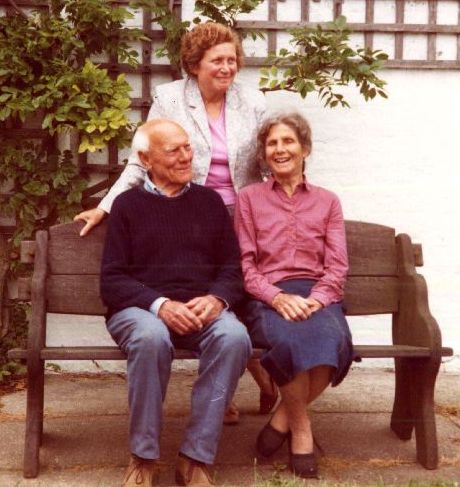
In 1982 the BBC aired “A Week with Svetlana,” documenting her visit at the Sussex home of Malcolm and Kitty Muggeridge. The famed defector discussed her experience as Stalin’s daughter and the growth and stability of religion in the USSR.

The program was positively received. One woman wrote to Muggeridge, “…It was so very interesting to meet Svetlana, whose faith has sustained her through her joys and sadness…Her conversation, riveting and evocative, reminded me of my young days…Eager to create a brave, new world…” Another wrote: “My heart has been set singing after watching on the television yourself and your guest Stalin’s daughter…The pictures of your house, the garden and the dear English countryside was a feast indeed. Even more, was the unwavering faith of your guest. ‘Christ is alive!’ Hallelulah, my heart replies…”

“You can’t regret your fate,” Svetlana once remarked, “although I do regret my mother didn’t marry a carpenter.” She authored two autobiographies, Twenty Letters to a Friend and Only One Year.

The papers of Malcolm Muggeridge (SC-04) are maintained at Wheaton College Special Collections.

A.A. Milne

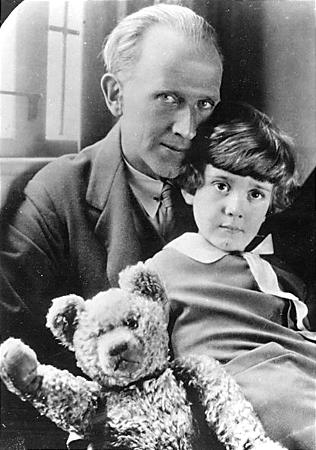
Alan Alexander Milne was born in Kilburn, London, England in 1882 and grew up at Henley House School, a small independent school in London run by his father. One of his teachers was H.G. Wells who taught there in 1889-90. Milne later attended Westminster School and Trinity College, Cambridge, studying mathematics. While at Cambridge Milne edited and wrote for a student magazine, Granta, where he came to the attention of editors at Punch, a humor and satirical magazine. He would later work at Punch as an assistant editor. In 1913 Milne married Dorothy “Daphne” de Selincourt and together they had one child, Christopher Robin Milne, on whom was based the Christopher Robin character of his later Winnie the Pooh books. Milne retired to his farm after a stroke and brain surgery in 1952 left him an invalid. He died in 1956.

Materials on A.A. Milne and monographs of his works are located in the William S. Akin Rare Book Collection in the Wheaton College Special Collections.

“I kissed it more than once….”

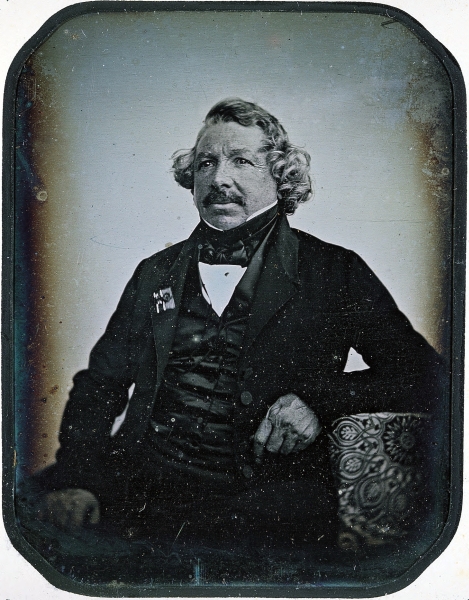
Louis DaguerreToday, November 18th, is the anniversary of the birth of Louis Daguerre. Born in 1787, Daguerre desired to capture the life and people around him in permanent form. He began to do this with dioramas, which he invented, in the 1820s. By 1826 he had learned how to do this using an early form of photography. Partnering with Joseph Niepce, Daguerre was able to hone the skills he learned in order to greatly speed up the photographic process. Because of this daguerratype photographs became quite desirable and all the rage. This is exhibited several ways within the holdings of the Archives & Special Collections.

David Maas wrote in Marching to the Drumbeat of Abolitionism how Civil War soldiers treasured the images they received from loved ones. He said, “Photography was a novelty and soldiers loved to carry tintypes or daguerreotypes in their Bibles. Wheatonite Webster Moses wrote, ‘I still have your picture, which is next to my Bible. Should you have any photographs taken please send me one.’ Luther Hiatt’s letters were full of incessant pleas for his fiancee to have her photograph taken and send it to him. ‘Tira I should have got a picture of myself yesterday taken in Murfreesboro, but I did not have time. If ever I do go to a place where I can get one taken I will do it. I am still looking very anxiously for yours, if you don’t hurry and send it I shall forget how you look.’ When the photograph finally came he was overjoyed: ‘I received your photograph….I was very much pleased to receive it and I kissed it more than once just as I should do if I were to be with you. ‘”

The Jonathan Blanchard letters show several instances of a similar desire to possess these fixed images that Daguerre helped bring to the average person. In 1855 Jonathan Blanchard wrote to his daughter, Mary, who was away at school, asking for a daguerreotype of her. Also, Mary Blanchard’s mother, Catherine Avery Bent wrote to her in 1860 that she was having daguerreotypes taken of her parents’ portraits. Very quickly individuals saw the usefulness of recording information, in this case painted portraits, using the photographic medium.

Jonathan Edwards letters arrive at Wheaton

In recent days a collection of letters related to Jonathan Edwards, noted preacher, theologian and prominent figure of the Great Awakening, have been placed on deposit at the Wheaton College Special Collections. These sixteen original letters written by or to Jonathan Edwards were written from 1752 to 1756 and were previously held by the Rhode Island Historical Society. Noted Edwards biographer George Marsden cited one such letter from Elisha Williams to Jonathan Edwards written August 19, 1752 in his book Jonathan Edwards: A Life. The following letter highlights Edwards’ work as a missionary among Native Americans, namely the Mohawk people of upstate New York.

The Jonathan Edwards collection is available to researchers and students in the Manuscripts Reading Room of the Billy Graham Center (map). An exhibit featuring the letters is being planned for Fall 2012.

Dr. Elsie Storrs Dow

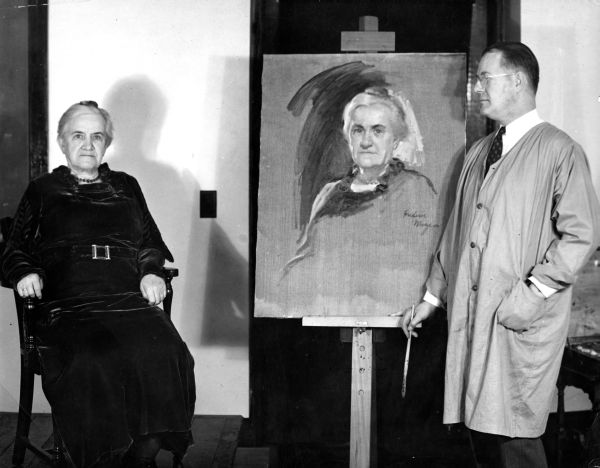
The stocky lady in the long black dress, striding confidently on short legs from class to class, was Dr. Elsie Dow, authority on Shakespeare and Browning. Born in Sycamore, Illinois in 1859, she graduated from Wheaton College in 1881. After employment in high schools and academies, she returned to Wheaton in 1889 as Professor of English Language and Literature. In addition to teaching Classics, History, Mathematics and English, she also served as registrar. Dow studied at Harvard, and in 1922, because of her outstanding achievements in literature, Lawrence College conferred upon her the Doctor of Letters degree. Popular on campus, she was in demand off campus, as well, as reader and speaker.

At the 1937 Homecoming chapel Dr. Buswell presided over the unveling of a portrait of Dow done by Frederick Mizen of Chicago. Herman Fischer accepted the painting for the college. After Elsie Dow spoke, Mignon Bollman McKenzie sang a special number composed for the occasion by Marion Downey and Corinne Smith. The piece was a musical setting of Miss Dow’s poem, “Whatsoever Things are Lovely.” The service was concluded with a benediction by Darien Straw.

For the 1941 inauguration of V. Raymond Edman she wrote:

My word of greeting to our new president is a very sincere welcome from the old to the new. I have been on this campus long enough to have been under the administration of each of our four presidents, and Wheaton has been to me in turn — President Jonathan Blanchard, President Charles Blanchard, President J. Oliver Buswell, Jr. — as it is to me in days to come, President Edman…I see the picture clearly, it is the heroic type. Wheaton will not be Wheaton if it ever loses that type as its head.

Upon her retirement in 1942 Darien Straw wrote:

When Miss Dow began teaching here she was an experienced teacher. Teachers were invited for reasons. I do not know that they ever applied for the job. Schedules were thirty hours a week. Salaries were low and pro-rated, so that the College was kept out of debt by paying all bills, and what was left was apportioned among the teachers with the understanding that accounts were closed at the end of each year. I doubt whether she ever had a written contract for salary yet. She taught all around the curriculum; if a department was short, she could substitute. It is rare for a woman to take a man’s chair and hold it for more than half a century. She did it. Always poised, always sedate, a thousand abstract Christian virtues embodied in the concrete; a walking literary library, with no slang version; among her pupils admired, among her students loved, wherever known and respected; Doctor Dow is thus held in high esteem by the trustees and carries with her ever their benediction and felicitation.

In 1944 100 friends honored Dow on her 85th birthday, visiting her home at 527 Kenilworth. Two outstanding features of the decorated dining room were the large centerpieces of red roses and two two-tier cakes; the latter were brought from Ann Arbor, Michigan. Miss Julia Blanchard assisted with refreshments during the afternoon. Friends and alumni, ranging throughout her 50-year teaching career, offered congratulations. Miss Dow received cards, flowers and gifts from those who could not attend. Special verse messages by Darien Straw and Judge Frank Herrick were read.

She died on October 29, 1944.

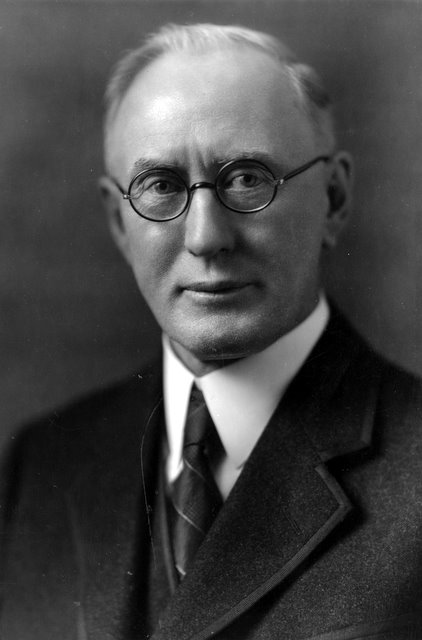
Orrin Tiffany

Orrin E. Tiffany was born March 27, 1868 to DeWitt and Lidia Parker Tiffany and grew up in Havana, Minnesota. After the death of his first wife of twenty-five years, Grace English, Dr. Tiffany married Kathrine Bellanger MacDonald in 1925. Dr. Tiffany came to Wheaton College in 1929 as Chairman of the Department of History and Social Sciences, and was Professor of American and Recent World History until his retirement in 1945. Among his students and faculty colleagues he was well known for his interest in world affairs; former graduates of the department frequently wrote to him for his views on international developments. Tiffany earned his A.B., A.M., and Ph.D. degrees at the University of Michigan, and was among the first recipients for the Phi Beta Kappa honor shortly after it was offered. In 1945, Seattle Pacific College conferred on him the honorary degree of Doctor of Laws. Before coming to Wheaton College, Dr. Tiffany held professorships and administrative posts at Greenville, Western Maryland, Seattle Pacific, and Whitworth College. In 1945 he attended the United Nations Conference on international organization in San Francisco. His most important contribution to scholarly writing was The Relations of the United States to the Canadian Rebellion of 1837-1838, published by the Buffalo Historical Society, and considered by recent historians as still “the most detailed study” and “the most satisfactory treatment of the subject.” Tiffany died February 2, 1950.

The Tiffany Memorial Lectures were established nearly fifty years ago in 1952 at Wheaton College in honor of the late Dr. Orrin Edward Tiffany. The aim of the Tiffany Memorial Lecture on Foreign Affairs is to foster interest in and understanding of international affairs on the college campus. Past speakers include Kenneth Landon, Robert McNamara, Zbigniew Brzezinski, Mark Hatfield, John Lewis Gaddis, Robert Pastor, Anthony Lake, Robert Seiple, and James Turner Johnson.

The Orrin Tiffany Papers are available to researchers at Wheaton College. The collection contains general biographical information on Dr. Tiffany, including information regarding his activity at Greenville College, Seattle Pacific College, Whitworth College, and Wheaton College. There are materials related to his book, Canadian Rebellion, and a series devoted to the Tiffany Memorial Lectures at Wheaton College. The materials relating to the Tiffany Lectures comprise the bulk of the collection.