 The seven authors featured in Wheaton College’s Wade Center are well-known: C.S. Lewis, J.R.R. Tolkien, Dorothy Sayers, George MacDonald, G.K. Chesterton, Charles Williams and Owen Barfield. The acquisition of manuscripts, both primary and secondary, surrounding these authors was masterminded by Dr. Clyde Kilby, professor of English. Through the 1960s and 1970s Kilby cultivated a wide-ranging network of relationships with collectors, authors and librarians, laboriously assembling the collection that provides the heart of the Wade Center. A lesser-known fact is that Kilby pursued material from other “mythopoeic” creators, most of which did not make it to Wheaton College. A spectacular example of “the-one-that-got-away” is Mervyn Peake (1911-68), English poet, illustrator and deviser of the gothic Gormenghast Trilogy. Peake, the son of medical missionaries to China, wrote of the ancient, gargantuan Gormenghast Castle inhabited by the mad Groan family and the subsequent birth and adventures of its royal heir,
  Titus. Peake intended to continue the narrative, but the series sadly ended with his early death from Parkinson’s Disease, leaving the third volume, Titus Alone, somewhat patchy. He counted among his admirers C.S. Lewis, who wrote at least two fan letters, and Orson Welles, who once bought cinematic rights, as did Gordon Sumner (also known as Sting) and Monty Python’s Terry Gilliam. Gormenghast was finally filmed in 2000 by the BBC, starring Jonathan Rhy Meyers, with Christopher Lee and Fiona Shaw among its supporting cast. The somber, opulent tale was voted by British readers as one of the Top 100 Books, ranked with such luminaries as Orwell, Austen, Tolstoy and Dickens. Though Peake was a contemporary of Lewis and Tolkien, he was decidedly bourgeoisie in taste and temperament, and viewed with disdain these seemingly-elitist Oxford dons. Shortly after Peake’s death Kilby contacted his widow, Maeve, requesting an opportunity for discussion regarding the archiving of Peake’s papers at Wheaton College. Maeve responded that, due to her still-raw grief, she was unable to talk at that time. They eventually met in England during the summer of 1969. However, the plan was aborted and Peake’s papers remain largely uncollected under one roof, though the family continues seeking an archive. Kilby’s papers (SC-90), including his correspondence with Maeve, are housed in Special Collections at Wheaton College.
All posts by Keith Call
James Bond at Wheaton College
Ian Fleming wrote 14 James Bond titles before his death in 1964. The series was continued with varying degrees of success by Kingsley Amis, John Gardner, Raymond Benson (who resides in suburban Buffalo Grove, Illinois), Sebastian Faulks with Devil May Care (2008) and Carte Blanche (2011) by Jeffery Deaver, who hails from Glen Ellyn, Illinois. Reviewing Dr. No for Christianity Today, professor Clyde Kilby remarked: “I discovered no St. George but only a salad of mystery entertainment, with a tart dressing of sex. On the whole…a very contrived performance.”
Amid all that globe-hopping, did Bond visit Wheaton, mistaking it, perhaps, for Monte Carlo? He came closest in Benson’s brief tale, “Live at Five,” which places the Brit in Chicago on a mission. Fleming himself once visited the Windy City, touring mob-related hotspots; and the Ian Fleming Foundation is currently located not in London, Rome or Paris, but in Kankakee, Illinois. However, Bond’s other literary and cinematic guardians are aware of us. For instance, in his Memoirs, Amis — who penned the 007 pastiche Colonel Sun and allegedly finished The Man With the Golden Gun, incomplete at Fleming’s death — laments the absurdity that  Malcolm Muggeridge’s typewriter is displayed “…in a glass case as part of a collection…including T.S. Eliot and C.S. Lewis.” (Actually, the typewriter is in Special Collections SC-04.) Another contributor to the 007 mythos is Bono, who visited Wheaton College with his entourage in 2002, drawing attention to the AIDS crisis in Africa; he is co-lyricist (with The Edge) of the title song for Pierce Brosnan’s GoldenEye, sung by Tina Turner. There is Marvin Hamlisch, who conducted the campus orchestra for the Artist Series in 2004; he achieved fame composing music for several hit films, notably the soundtrack for Roger Moore’s The Spy Who Loved Me. And then there is Dr. Michael Ward, C.S. Lewis scholar and author of Planet Narnia, who has spoken at Wheaton College. Portraying Q’s assistant in The World is Not Enough, Ward hands Pierce Brosnan a pair of x-ray sunglasses.
Trumpet Call to Wheaton
It has been wisely suggested that each incoming Wheaton College student mandatorily read The Silver Trumpet (1930) by J. Wesley Ingles. The Silver Trumpet received the John C. Green Award from the American Sunday-School Union as its unanimous choice for a manuscript whose subject was “the heroic appeal of Christianity to young people.” It went through nearly two dozen printings through the 1950s, later republished under the title The Amazing D. Randall MacRae (Moody Press) and has made its way online as an “on-demand” book through Amazon.
 Dedicated to “President Charles A. Blanchard who, of all my teachers, has left the deepest and most abiding impress upon my life,” the novel follows the fortunes of D. Randall MacRae, wealthy worldling and hotshot football hero who, pursuing a pretty young lady, reluctantly transfers from magnificent, ivy-walled Princeton to backside-of-nowhere “Wharton College,” a repressive “fundamentalist” institution situated somewhere west of Chicago. MacRae painfully adjusts to campus life, fumbling about with less certitude than his athletic reputation might suggest. His anxieties are gradually lightened as the semester progresses and he at last secures sweet romance–along with a genuine, humbling faith in Christ. An airy, wholesome romp, Ingles’s tale conjures the gentler, courtlier moods of the pre-War Midwest, the imminent thrill of the Big Game against North Central, autumn’s chill and the coloring leaves against gray skies, blossoming friendships in depressed times and the promise of bright young lives wholly devoted to Christ. In a day when there was no other “safe” place to attend college, alum of a certain age point to an early reading of The Silver Trumpet as the deciding factor for choosing Wheaton College, a fact bolstered by Rudolph Nelson in his biography of Edward Carnell. He notes that “Dr. V. Raymond Edman…administered a questionnaire to freshmen one year during the forties. In response to a question concerning their reasons for having decided to attend Wheaton, more than half of the entering class included in their list a reading of The Silver Trumpet” (p. 28).
Rockwell at Wheaton
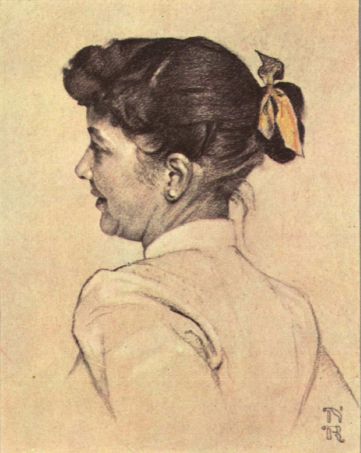 A copy of Norman Rockwell’s autobiography, My Adventures as an Illustrator (1960), archived in our Rare Book Collection (SC-10), boasts an intriguing inscription: “My best wishes to the art department at Wheaton College, sincerely, Norman Rockwell. My late and beloved wife, Mary Barstow Rockwell, was a native of Wheaton.” At the bottom of the page is another handwritten note, declaring that the book is dedicated to Mary, and directs the reader’s attention to her portrait on page 9, seen here.
Mary was the daughter of Alfred E. Barstow of California, and (Dora) Bernice Gary of Wheaton, IL; Dora, who took science courses at Wheaton College, was the niece of the famed U.S. Steel founder and Gary, Indiana namesake, Elbert Gary. Mary, born November 26, 1907, studied education at Stanford University Graduate School.
The circumstance under which the book was signed is not known. Rockwell divorced his first wife, Irene, in 1930. He was married to Mary from 1930 until her death in 1959, after which he married Molly Punderson in 1961. The famed Saturday Evening Post illustrator died in 1978 at his home in Stockbridge, Massachusetts.
Utopians on the Prairie
Two years after Joseph Smith, the Mormon seer and revelator, was murdered by a mob in Nauvoo, Illinois, another failed utopia took root 100 miles north in Henry County–this one founded by Erik Jansson, the Swedish pietistic prophet with hypnotic eyes who, claiming “sinless perfection,” publicly burned the works of Martin Luther. Fleeing Europe three hundred years after Luther’s death in 1846 with 1200 followers, he embarked on a perilous migration to the United States. From New York the Janssonists sailed via the Great Lakes to Chicago, then rode wagons 180 miles west across rolling grasslands before halting on a fertile patch not far from the Mississippi.  Here they settled the village of Bishop Hill, farming and constructing brick buildings in the same style as those of their homeland. In fact, the church, harness shop, hotel and other structures yet stand. A quick terminus arrived in 1850 when Jansson was shot and killed by John Root, who had married the prophet’s cousin with intent to move away with her, but had been prevented by the commune. Janssonist activities generated such disturbance that Jonathan Blanchard, then-president of Knox College in nearby Galesburg, asked Milton Badger, secretary for the American Home Missionary Society, in an 1848 letter if any ministry could be extended to “these Swedes,” in addition to recommending that a Swedish Lutheran pastor work with “refugees” from the Janssonists. The village struggled after the death of its founder, and was dissolved in 1861.
Democratic Presidential Nominee visits Wheaton
 In 1921 Wheaton College proudly hosted William Jennings Bryan (1860-1925). The former Secretary of State under Woodrow Wilson, three-time Democratic presidential nominee, social reformer, lawyer and unswerving Presbyterian fundamentalist addressed a standing-room-only assembly for an evening service in Blanchard Hall’s compact Fischer Chapel, which had seen the likes of D. L. Moody and Jane Addams. According to student Edward Coray, Bryan “was a fascinating speaker and spiced his message with some good humor.” Known as The Great Commoner for championing causes like prohibition and women’s suffrage, he lectured forcefully to faculty and students against the theory of evolution, later using those very arguments in his seminal debate with attorney Clarence Darrow during the 1925 Scopes Monkey Trial. Exhausted, Bryan expired in his sleep five days after the verdict was declared, his death compounded by weight and cerebral hemorrhaging. He is buried in Arlington National Cemetery. To this generation when one thinks of Democratic Conventions the 1968 Chicago Democratic Convention can come readily to mind, but in 1896 Bryan, at age 36, addressed a less-raucous, but no-less significant Democratic Convention in Chicago with his historic “Cross of Gold” speech, which responded to the those demanding a currency based upon a gold standard. Bryan shouted, “we will answer their demand for a gold standard by saying to them: You shall not press down upon the brow of labor this crown of thorns, you shall not crucify mankind upon a cross of gold.” (The Billy Graham Center Archives contains a recording of Bryan redelivering this speech) Sadly, many don’t remember the compassionate statesman. Bryan is cruelly satirized as the oafish “Matthew Harrison Brady” in the 1955 Broadway smash, Inherit the Wind. However, R. G. Lee, the eminent Southern Baptist pastor and convention president, memorialized him as “a mighty statesman eagle, quarreled at but not hindered in his lofty flight, by the noisy human sparrows of his day who envied but could not attain unto his eminence.”
The Martian and Miss Fuller
Upon graduating from Wheaton College in 1923, Muriel Fuller studied journalism at various universities before embarking on a celebrated career as editor, writer, and reviewer.  A keen litterateur, she was employed with Rand McNally, Thomas Nelson and the Greystone Press. At Wheaton her roommate was Margaret Landon, author of Anna and the King. In fact, it was Fuller who encouraged Landon to write it. Fuller possessed a rare gift for not only placing her finger on exactly what was wrong with a manuscript, but also offering pointedly useful suggestions toward correcting the problem. Fifteen published books are dedicated to her, with further evidence of her high regard seen in a short 1950 typewritten reply from Ray Bradbury, archived in the Fuller Family Papers (SC-87). As a professional reader for both Redbook Magazine and the O. Henry Memorial Award, she evidently tendered a few friendly remarks, including advice about assembling his stories into an anthology. Bradbury responded with gratitude and availed himself to chat as opportunity allowed. Recently the 88-year-old Los Angeles-based author of Fahrenheit 451 and The Martian Chronicles was alerted to the fact that Wheaton College’s Special Collections has the letter. “I want it!” he said. The staff sent a copy to Bradbury. When it was read to him, he exclaimed, “That’s wonderful!” before tucking it into his voluminous files.
A Forgotten President
 When President Charles Blanchard died from a heart attack at age 77 in 1925, Dr. John Wallace Welsh, pastor of College Church, college trustee and occasional instructor, was called to serve as acting president ad interim. Blanchard’s successor was originally intended to be W.H. Griffith-Thomas, the Reformed Episcopal author, Keswick Conference preacher and co-founder (with Lewis Sperry Chafer) of Dallas Theological Seminary. The plan was that Griffith-Thomas, when asked to join the teaching staff in 1923, would eventually assume the presidency; but the eminent theologian declined the offer.
Before coming to Wheaton, Welsh, a native of Elmira, N.Y., pastored in Princeton, IL, at the church once led by abolitionist Owen Lovejoy, an original trustee of Wheaton College. During his Princeton years, Welsh enjoyed close association with evangelist Billy Sunday, who preached a sweeping revival from Welsh’s church. The 1927 Tower describes Welsh as “…resourceful, self-reliant, aggressive, unceasing…” He had two sons: John, Jr, who became the college’s first physician, and Evan, who also served as pastor of College Church (1933-46), and later as chaplain for Wheaton College Alumni Relations. John W. Welsh served faithfully during uncertain days until a young evangelist named J. Oliver Buswell was unanimously elected as Wheaton’s third president in 1926. Shortly thereafter Welsh retired from College Church and moved west to do field work for the Los Angeles Bible School. He received an honorary degree in 1925 from Wheaton College. Welsh died in 1947 at age 73 in Newton, Kansas, following a stroke. In addition to his sons, Welsh was survived by his wife, Mary.
Marshall Fields and the King of Siam
 Margaret Landon first read the writings of Anna Leonowens in 1935, while laboring with her husband, Kenneth, as missionaries in Siam. Enthralled by this exotic tale of a young English widow and her son living among Siamese royalty, Margaret determined to edit and recast Leonowens’ autobiographies, The English Governess at the Siamese Court (1870) and The Romance of the Harem (1872), as historical fiction, removing lengthy expository sections and sequentially arranging incidents. But those books were long out-of-print. Where might she secure copies? After extensive searching, Kenneth spied an edition of Romance at the Economy Bookstore in Chicago; a few weeks later, Margaret happened upon Governess at the Marshall Field flagship store on State Street, after a half-hour hunt among tottering stacks of books. Delighted, she paid fifty cents. Margaret then collected correspondence and other material pertaining to Leonowens, and set about her arduous task. Finally, in 1945 she published Anna and the King of Siam, providing the basis for a yet another successful re-tooling, Rodgers and Hammerstein’s musical The King and I. “If I were asked to give the fabric content of the book,” she commented, “I should say it is seventy-five percent fact, and twenty-five percent fiction based on fact.”
Leanne Payne autobiography published
 Leanne Payne’s autobiography, Heaven’s Calling: A Memoir of One Soul’s Steep Ascent (2008), unfolds the ever-rolling road of an extraordinarily rich and adventurous faith-life, moving gracefully from her childhood to her years as a student at Wheaton College, and finally to her role as author and founder of Pastoral Care Ministries. She describes her passion for healing prayer and sacramental worship, emphasizing the necessity of Christian emblems when re-educating the paganized, or “bent,” mind toward contemplating the holy things of Christ. Along the way she recognizes mentors such as her mother, Charismatic pioneer Richard Winkler and author/teacher Agnes Sanford, Payne devotes an entire chapter to the late Dr. Clyde Kilby. “To say that my debt to Dr. Kilby is very great indeed is to understate the case,” she writes. Payne highlights his efforts in publicizing the works of C.S. Lewis, in addition to describing the unhurried simplicity of Kilby’s classroom teaching and devotional life, both a continuing inspiration to students and notable graduates, including pastor John Piper, author Thomas Howard and poet Luci Shaw. Payne’s prose is musical and distinctly feminine. Her walk of faith is an upward path, and she inspires her readers to a celebration of life in Christ. Leanne Payne’s papers are classified as SC-125 in Wheaton’s Special Collections.