The Prohibition Club


The matter of casual consumption of alcohol is increasingly accepted among Christians, but in previous generations “the drink” was considered an insufferable evil — a quick, sure agent for destroying the family and the community. One tract from 1922 notes, “The children of this generation must be taught that alcohol is present in beer, wine and home-brew, and that alcohol, wherever found, is a poison.” Evangelists such as Billy Sunday continuously railed against the dangers of booze, preaching with such aggression that saloons and bootleg operations shut down all across the country.

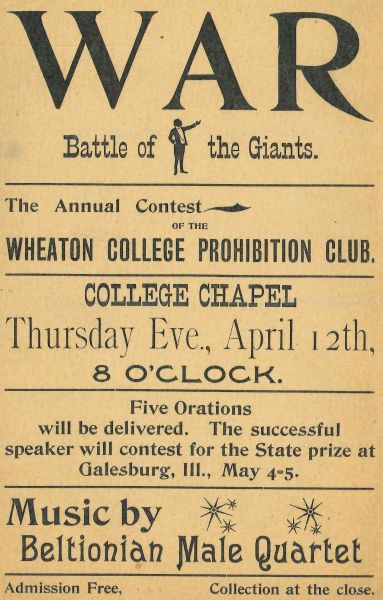
Assisting in the battle for temperence, Wheaton College established the Prohibition Club, which eventually aligned itself with the Intercollegiate Prohibition Association. Students, traveling to schools and churches, performed oratories and wrote contest essays with such themes as “The World Movement Against Alcoholism. Charles Blanchard, second president of Wheaton College, delivered the keynote address for the third annual convention of the Intercollegiate Prohibition Association of Illinois in 1895, hosted at Wheaton College.

Modern sensibilities might disagree, but voices from the past proclaim their opposition with conviction.

Nuturing a Passion for Justice

by Helene Slessarev

Scripture speaks so eloquently of God’s passion for the poor and the outcast. Throughout my adulthood, I too have had a passion for seeking justice for the poor. Prior to coming to Wheaton, I had worked as a community organizer in an all-black neighborhood in Chicago, as an advocate for stronger civil rights legislation and job training programs for the poor, and as an organizer for several local reform politicians. I saw coming to Wheaton as a continuation of my calling to a ministry of justice because it was my hope that through teaching and writing I would be able to impart those passions to my students.

Every year I have new students in my classes who have been inspired by a church missions trip or an urban immersion experience and are now eager to learn more. They understand that Christian leadership means service, and they want to know how they can best live that out in what they choose to do as adults.

A growing number of Wheaton students are wrestling with a sense of calling to some form of urban ministry as they prepare for adulthood. For them, urban studies can serve as a window into what in most cases is a very different environment, while also serving as a window into their own souls.

As director of urban studies, I see it as my calling to broaden and deepen my students’ thinking about poverty so they can clearly see the impact of societal evils in creating and perpetuating poverty and hunger in the world. Unlike the students I taught at the University of Chicago when I was in graduate school, Wheaton students’ faith serves as a common foundation. They come into the classroom knowing that God expects them to serve the hungry, the homeless, the sick, and the needy, because “when you did it to one of the least of these, my brothers and sisters, you were doing it to me” (Matt. 25:40). I seek to present them new perspectives on Scripture, often drawing on the prophets of the Old Testament such as Isaiah, Jeremiah, and Ezekiel, as well as Jesus’s own ministry among the outcasts of Jewish society.

I seek to challenge many of my students’ assumptions about the life conditions and hardships that confront people who live in the poorer communities of our nation’s big cities. They are accustomed to thinking about poverty as an individual problem, yet the growth of large poor neighborhoods in central cities is also the legacy of housing and school segregation, the loss of industrial employment, and flight of financial capital.

For young Christians to seriously engage in ministry among the poor, they have to recognize that there can be no genuine solution to poverty in America unless those most hurt by it become actively engaged in the search for solutions.

Young Christians trained in Christian colleges like Wheaton who are seeking to do urban ministry will have to form partnerships and share skills and experiences with Christians who have grown up in these communities. For many students, their urban experience will be life-transforming because they learn that to be a light in this world requires that they give of themselves. They have to empty themselves in order to serve others. They learn that there are no easy solutions to renewing poor communities and that any change requires great love, hard work, and deep commitments.

———-

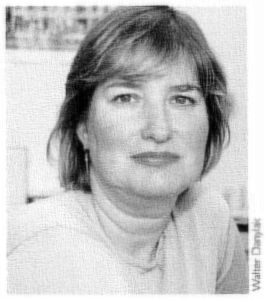
Twenty years ago, the Wheaton Alumni magazine began a series of articles, titled “On My Mind”, in which Wheaton faculty told about their thinking, their research, or their favorite books and people. Former Associate Professor of Political Science and Director of the Urban Studies Program, Helene Slessarev (who taught at Wheaton from 1991-2006) was featured in the Summer 1999 issue.

Blanchard Hall, the City of God?

All editions of Pilgrim’s Progress describe a thrilling scene in which Christian is directed to the heavenly city by Evangelist. However, the 1931 Wheaton College Tower front flyleaf illustration slightly tweaks the old story, instead upholding Blanchard Hall as the celestial destination. Other such images are featured throughout the volume. Using the theme of pilgrimage, editors from the Junior Class write:

As Christian travelled his way full of difficulties and temptations toward the Light, we as students are wending our way to the same Light. Thus realizing these few years at Wheaton are but a milestone on our way, the Tower ’31 portrays our Pilgrimage.


Two Freds, One Faith

One could hardly imagine two more disparate Presbyterian ministers than Fred Rogers, best known as beloved children’s show host “Mister Rogers,” and Pulitzer Prize-nominated novelist Frederick Buechner. One man, wearing a zippered cardigan, sings “Won’t you be my neighbor?” before placidly discoursing on themes such as courtesy, personal hygiene or regular school attendance; the other writes decidedly “grown-up” fiction and non-fiction, frankly discussing the crippling tensions he has felt between faith and doubt. One man’s pulpit is television; the other’s pulpit is his desk. Both are influential in vastly different spheres.

Nonetheless, the two Freds interacted during the early 1980s. Among the papers of Frederick Buechner (SC-05) are three notes from Mr. Rogers. For the first two, dated July 14, 1981, Rogers thanks Buechner for a phoned chat, and for “…what you called out of me.” Rogers then invites Buechner to visit him during August if he is near Pittsburgh or his summer home in Nantucket. On the other note he writes his address. On the third, dated August 27, 1981, Rogers thanks Buechner for sending a gracious letter which welcomed his return to Nantucket. He also thanks Buechner “…for you and your superb work.”

(Researchers desiring access to those portions of the collection classified as Private Materials or Special Private Materials must obtain written permission from the Buechner Literary Trust.)

Wheaton College Awakenings: 1853-1873

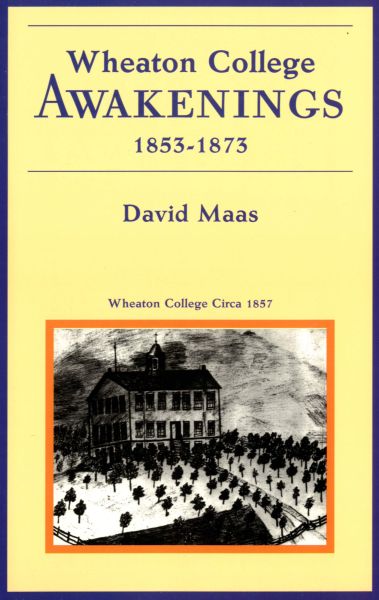
Before publishing Marching to the Drumbeat of Abolitionism: Wheaton College in the Civil War (2010), Dr. David Maas, retired professor of history, released Wheaton College Awakenings: 1853-1873 (1996), comprising 266 entries excerpted from correspondence, diaries, newspapers and other printed matter, chronicling early campus life.

A few examples:

#18. Discipline of studying, 1857. And if the discipline of study ever accomplishes anything it must be self-imposed. The student who needs a police force to exact obedience to academic law deserves no place in a respectable literary institution.

#37. Student attacks novel as trashy literature, 1857. The country is flooded with books and papers which have a tendency to excite and intoxicate the mind; consequently the mind becomes poisoned and the desire for useful information is destroyed and all the noble powers of the intellect die of starvation or from the want of wholesome intellectual food…[too many read] worthless nonsensical trash which has a tendency to destroy the virtue and morality of the consumer. [Great men of the past] Webster, Clay, Washington and Sumner…[did not] rise to the highest pinnacle of fame by spending their time novel reading…Young man, beware, beware of that young lady who spends most of her time in reading novels, talking nonsense and laughing at others…

#97. Professor critical of the architectural style of central section of Blanchard Hall, 1868. [Professor John Calvin Webster in address dedicating the cornerstone of the west wing of Blanchard Hall refers to the original center section as] the semblance of an old-fashioned New England cotton mill.

#106. Complaint of high costs of Wheaton, 1857. Although the world seems to frown on you now and by every means possible to take the last dollar you possess, particularly so if you are a student at Wheaton College.

#252. Student concerned about Civil War, 1861. It [imagination] sees the dark cloud which now overhangs our country roll away; and our nation purified by fire and blood – rising up with a halo of glory around.

At the Core

by Ivan J. Fahs ’54 Professor of Sociology

During our first year of marriage, Joyce was finishing her work at Case Western Reserve University in Cleveland, and I was teaching high school in nearby Euclid. One of my responsibilities was to supervise a study hall in the school’s cafeteria where the students typically spread out around the spacious room, some of them taking up a whole table.

One kid drew my attention. He was at a table by himself and was moving books and notebooks around, scribbling a note here and there. I noticed he was smiling, and I thought I could hear him humming, too. Now, when a teacher observes a kid smiling in a high school study hall, there are several possibilities–Is this kid concealing a frog or snake in his shirt and is he is planning to let it loose to test out this new teacher’s skill at riot control? And that smile–was it a smirk or a impious grin? Trying to appear authoritative, I wandered over toward his table. He was underlining in a book and sure enough, he was humming a bouncy tune, When our eyes met, I said, “You’re Brian, aren’t you?”

“Yes,” he said, And you’re new here, aren’t you?”

“Yes, I’m new this year. Brian, you seem to be enjoying yourself this morning. You’re smiling a lot, and I heard you humming a song. What gives? Why do you look so happy?”

Brian’s response was instantaneous and genuine. “O, that? That’s just the Lord shining through.”

Obviously, Brian had not been admonished sternly enough to keep God out of his life as a public high school student. The spontaneity and brightness of his faith–what was inside him–showed on his face and was evident in his voice.

Often many of us portray a positive appearance that does not nicely dovetail with the “stuff” inside ourselves. Which means that sometimes we force an appearance, and we deliberately, some would say dishonestly, act in such a way to appear to he something we really aren’t.

What is in the core of our being? When anyone is “in Christ,” that person becomes a new creation. Christ profoundly changes our core. With that transformation we become capable of absorbing and transmitting the qualities of His Spirit–love, joy, peace, long-suffering, gentleness, goodness, faith, meekness, and self-control.

This is the “good stuff” that presumably becomes integrated into the essence of who we are. If all that “good stuff” is an authentic part of me, then why doesn’t it bubble out more? Sometimes, I think it’s because we believe our Christian faith is a very private experience. But when we contemplate what Christ has done in us, how can we really keep it for ourselves? The “good stuff” is too good to be kept private. It is natural to spread the Good News everywhere. Another reason we don’t express what Christ has implanted in us is that we have not tended the garden inside adequately. Inside we are empty and sick and cannot bring ourselves to admit candidly how little of the “good stuff” we have. We need resuscitation, a new commitment to the Lord, or a refilling with His Spirit.

I struggle with dissonance between the realities of who I am and how I present myself. But I have learned from times like this that it’s okay, deeply okay, to let my core–even when my core is in a state of disrepair–to be revealed among caring people who love me in my brokenness; these people hold me up, and they send me on my way. That’s what Christian community life does for each of us who is needy. The personal and social toxins all around are minimized when caring people blow in spiritually pure air and offer us cool, refreshing cups of water. So even when we are less than the ideal, each of us has power to minister to one another with Christ’s Spirit and to overcome these toxins.

Because Jesus taught that every disciple when fully taught will be like his teacher (Luke 6:40), it is fair to ask who our teachers are. Cultural ways of doing things, religiously sanctioned beliefs, and focus on people’s physical appearances can distort the reality underneath. Our preconceptions about poorly clothed people, or someone illiterate or socially crude, can keep us from understanding the essence of who these children of God really are.

How well-rooted at our core are we in Christ-centered values? And does this “root system” function adequately when others need to see the authentic Jesus shining through? Does the Lord Jesus inside us make a difference in the way we appear to others? Does He come through spontaneously and joyously? Does He attract others to Himself?

I don’t know what is best for stirring us to deal with the incongruity of our inward reality with our outward behavior. Gentle persuasion and cogent argument work for some. A direct in-your-face approach works for others. It doesn’t matter. We must come to terms with a process of living before others in a way that draws upon the qualities God’s Spirit has imbedded in our inner core. Then we may be in the position where the mouth speaks out of the abundance of the heart (Luke 6:45).

———-

Twenty years ago, the Wheaton Alumni magazine began a series of articles, titled “On My Mind”, in which Wheaton faculty told about their thinking, their research, or their favorite books and people. Former Professor of Sociology Emeritus, Ivan Fahs ’54 (who taught at Wheaton from 1981-2001) was featured in the Autumn 1997 issue.

The Wheaton Anthology

During its early decades, the Wheaton College Record, the student newspaper, published verse written by faculty and students. However, as the editors, Raymond Horton and Charles Seidenspinner, observe in their introduction, “to publish a poem in a newspaper is to bury it.” Seeking to rectify this, they scoured thousands of pages, seeking “…the best representatives of the literary talent which has appeared on the Wheaton campus.” Compiling the best of the best, they collect their choices into a book called The Wheaton Anthology, published in 1932. Brief in pages, the anthology contains a number of interesting pieces, including a poem by Jonathan Blanchard, first president of Wheaton College. Also included are poems by Elliot Coleman, who later gained renown as a poet and professor at Johns Hopkins, and Royal T. Morgan, professor of natural sciences.

Children of Two Adams

by Laura Miguelez ’83

One of the most striking parallels the apostle Paul comments upon in Scripture is that of the First and Last Adam. The first Adam was to be the exemplar of all that is good in a humanity made in God’s image. Yet as Adam and Eve, who had only known good, chose to know evil in disobedience to their Creator, so follow we.

We, too, determine that God’s ways cannot be best and so choose to go our own ways. Nor do we see this condition as being problematic. When confronted with our failure to do good, we stand behind our first parents, claiming, “I’m only human”– claiming, that is, that we expect to fail in our quest to image a holy God.

Nor do we see how grievous this low expectation can be. We distance ourselves even more from our choices and speak of learning to “love the sinner” and “hate the sin” as though we were somehow capable of separating the two, not acknowledging that sin arises from the very inclination of our hearts. Sin is not ever disembodied “out there” somewhere, but exists in the context of the person committing it.

The only reality is that of the sinning sinner, and this is why Christ’s sacrifice is so pivotal: He died not for sin, but for sinners who could not keep themselves from sinning. We are children of the first Adam, a living being; children of dust. Yet we are called to be children of the last Adam, Jesus Christ, a life-giving spirit; children of heaven.

Jesus Christ–not Adam–is the one who defines for us what it means to be human. He chose to love the sinning sinner by dying on our behalf that we might know the love of God at work in our hearts by His cleansing Holy Spirit.

The basis of our being accepted before God does not change once we commit our lives to Him. We can come before God’s presence only because of what Christ has accomplished; we can remain in God’s presence only on the basis of the same.

And this is the great tension we feel in our earthly sojourn: that in God’s sight, as Martin Luther observed, we are at one and the same time both righteous–by Christ’s nature within us–and sinners–by our own nature. And although we continue to seek to
hide behind our human nature in explaining ourselves to ourselves, the reality is that Christ is the one to whom we should return. And this we will not do unless we understand ourselves to be sinning sinners.

Only we who are sick have need of a physician, and so we are told by Christ to “Go and learn what this means, ‘I desire mercy, and not sacrifice’ For I came not to call the righteous, but sinners” (Matt. 9:12-13).

And herein lies our hope: “Therefore, my beloved brethren, be steadfast, immovable, always abounding in the work of the Lord, knowing that in the Lord your labor is not in vain” (1 Cor. 15:58).

—–

Twenty years ago, the Wheaton Alumni magazine began a series of articles, titled “On My Mind”, in which Wheaton faculty told about their thinking, their research, or their favorite books and people. Former Assistant Professor of Theology, Laura Miguelez ’83 (who has taught at Wheaton since 1998) was featured in the Autumn 2000 issue

First Ladies of Wheaton College

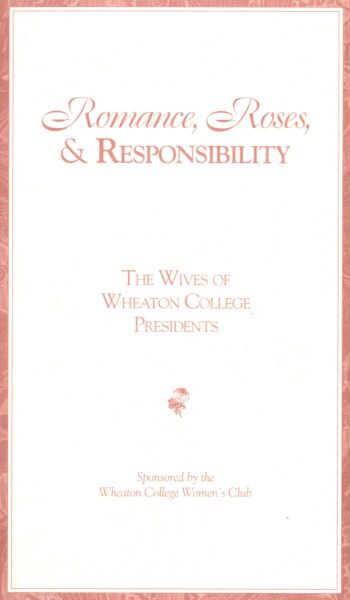
The presidents of Wheaton College are lauded for their leadership, guiding the institution through the decades, holding close its motto, “For Christ and His Kingdom.” But leadership is usually a partnership; and surely every man would respectfully defer to the invaluable contribution of his wife. Ruth Cording, former archivist at Wheaton College, composed a booklet, Romance, Roses and Responsibility, celebrating the lives of these faithful women. Cording profiles the following: 1. Mary Blanchard, wife of founder Jonathan Blanchard. 2. Margaret Ellen Milligan, first wife of second president Charles Blanchard, who died during her early motherhood. 3. Amanda Jane Carothers, second wife of Charles Blanchard, died from scarlet fever. 4. Frances Carothers, third wife of Charles Blanchard, who was a physician and wrote a biography of her husband. 5. Helen Spaulding Buswell, wife of J. Oliver Buswell, third president of Wheaton College. 6. Edith Olson, wife of V. Raymond Edman, fourth president. 7. Miriam Bailey, wife of Hudson Armerding, fifth president. 8. Mary Sutherland, wife of Richard Chase, sixth president. 9. Sherri Elizabeth, wife of Duane Litfin, seventh president.

Commenting on her use of the rose motif, Cording writes:

Mary Blanchard brought her roses from Cincinnati when she and her husband, Jonathan, Wheaton’s first president, came to Knox College in 1845. Those rose bushes were then transplanted to their home on South President Street when the Blanchards moved to Wheaton, In 1863 the bushes were moved to the college and planted in front of Blanchard Hall near the east door. Some of the bushes were also planted, at the request of Jonathan Blanchard’s granddaughter, Geraldine Kellogg Dresser, and when she died, former president V. Raymond Edman referred to the “heritage of roses,” stating that she “passed the Blanchard heritage to us with roses.” In 1984 I noticed that the roses in front of Blanchard Hall were just about ready to go into pink bloom, but that the remodeling of the front of Blanchard would threaten their blossoms. The college gardener was alerted and all the remaining bushes were moved to the front of Westgate, the current home of the Wheaton College Alumni Offices. They are now appropriately marked with plaques, showing that they were originally brought to Wheaton by Mary Bent Blanchard – 150 years ago!

The Orange and the Blue

Like any campus, Wheaton College proudly displays its colors. Orange and blue. Visiting, you will encounter orange and blue t-shirts, pennants, banners, posters, jackets, flags, blankets; and, during athletic events, energetic, noisy fans displaying bright orange and blue facepaint. Why these colors? The origin dates to Jonathan Blanchard, the founder of the school. Historian W. Wyeth Willard writes in Fire on the Prairie – The Story of Wheaton College:

Like his parents and all true New Englanders [Charles Blanchard] was proud of his ancestry. “My father and mother were Vermonters. There can be no better blood; it seems to me, than that of the English Pilgrims and Puritans.” In many of the Blanchards’ published addresses this note comes out time and again, along with mention of Plymouth Rock. But that did not prevent the Blanchards from admiring people of other ancestries. Jonathan wrote concerning the Swedes, “the merging of northern steel with Anglo-Saxon iron.” And he suggested that the College colors be orange and blue — orange after that great Dutch patriot, William of Orange, and blue for loyalty.